Link to Coursera - Emory Business Essentials Course: Link.
Instructor: John Kim.
Course - 1 : Introduction
ROUGH NOTES (!)
Updated: 16/9/2026
[Module 1 Intro]
[What is MBE (Mastering Business Essentials)?]
When I was younger, I thought “business” was all about money and greedy companies. Now, I realize business is fascinating, empowering, and fun. Business = doing great work for customers and getting paid for the work. The world’s biggest and most complex problems will be solved when government & business & community & individuals work together. There is not a single “skeleton key” answer, but learning the top 150+ MBE frameworks will help.
[Who should take this course?]
Instructor’s opinion:
-
Business doesn’t have to be complicated.
-
Let’s make it easy to understand and useful.
We will consider:
Core concepts: Self explanatory.
Linkage: How is it linked to your goals?
Tools: To practice and use the stuff.

Course is designed with three groups in mind:
-
Graduates
-
Managers
-
Entrepreneurs
Graduates:
(Graduates who did not study business or want a refresher)
Idea: Build up confidence before the interview. Do great, get the job offer.
-
Get smart on business concepts quickly.
- Prepare for interviews
- Company
- Industry
- Specific role
- Start strong; do great work with new job.

Managers:
(Managers promoted into roles that require more business)
Idea: Understand business, not just your job. Become “executive material”.
Idea Get more done with same resources.
Typically: Do good work –> Impress boss –> Promoted —> Impress boss —> Promoted etc.
Eventually you reach a point where you must have a broad view, not just one function. Eg, work with marketing, R&D, manufacturing, etc.
You need to be able to persuade people with data.
-
Develop a broader, more executive view of the business challenges.
-
Make better decisions; persuade with data.
-
Influence others (departments / leaders).
-
Goal: Get more done with same resources.

Entrepreneurs:
(Entrepreneurs looking to start a new business)
Idea: Business is difficult. Use tools. Make money, win.
Typically you’ve identified a gap in the market, and where you can be of help. You have something you’re good at, a strength.
You’re putting your own money at risk. You’re like a solo pilot flying a plane. How do you get customers? How do you keep them? How do you get them to tell their friends about it? How do you explode this business and make a lot of money?
The focus is on marketing, strategy, cost reduction, operations, etc. Setting you up for success.
- Find a gap in the market for your product/service.
- Strong market need.
- Fits your strengths.
- Position differently.
-
Acquire customers and drive word-of-mouth.
- Drive business profits.

Business is a massive topic. There is not a simple “skeleton key” that unlocks all the answers.
Business comes in all flavors, sizes, and situations.
Yes, there are patterns. Gotta stay curious.
Let’s learn the basics quickly; then practice applying it.
(If you want to deep dive into a topic, you can use other courses on Coursera)

Learning business is like learning how to cook.
You need to know the ingredients (eg: eggplant, carrot, onion), tools (eg: stove, microwave, pressure cooker), recipes (eg: you don’t need to reinvent the wheel, you can follow for eg your grandma’s recipes)

Quote of the day:
Free education is abundant, all over the Internet.
It's the desire to learn that is scarce.

- Naval Ravikant.
[What do you mean by “business”?]
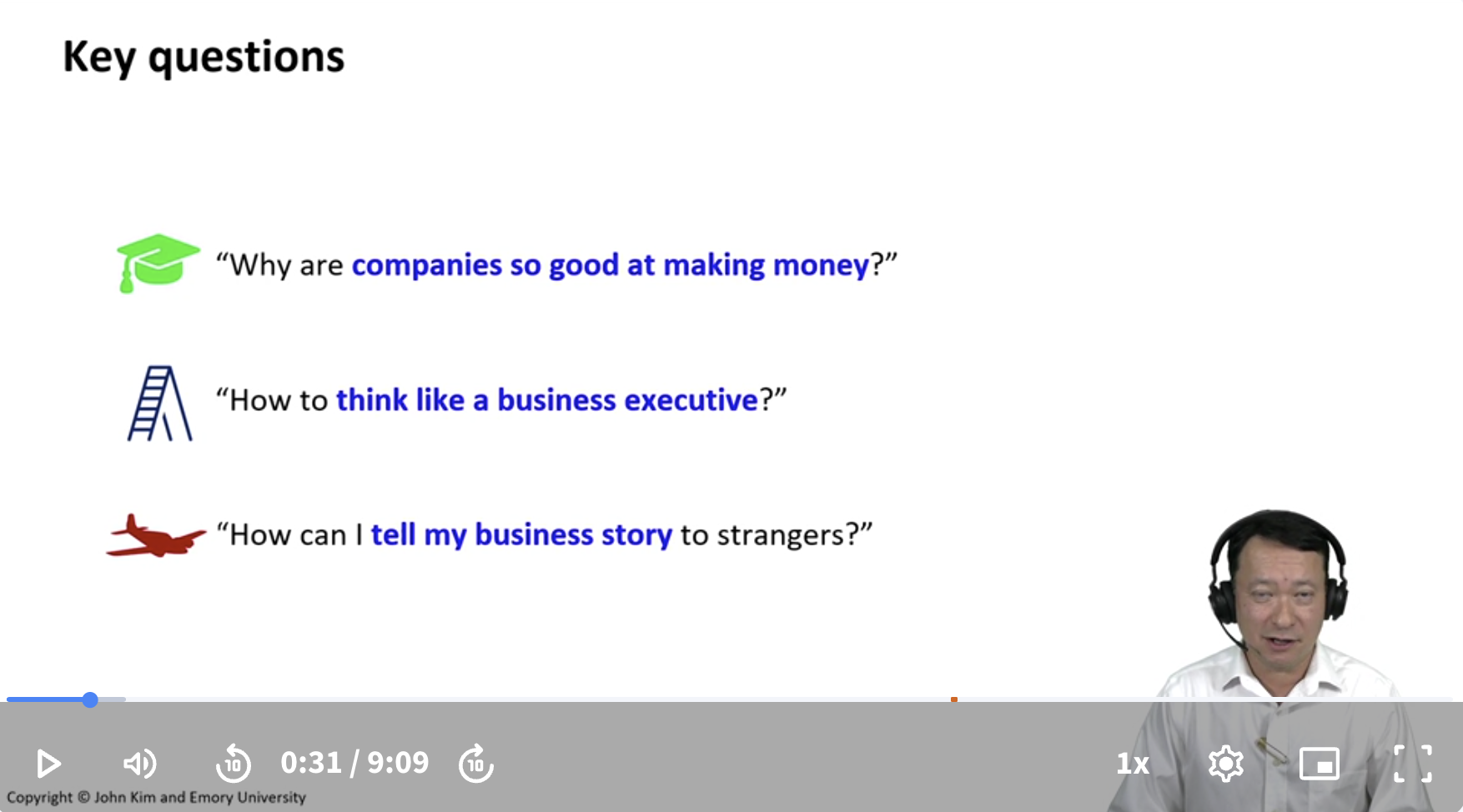
Key questions.
People might ponder.
Grads: “Why are companies so good at making money?”
Managers: “How to think like a business executive?”
Entrepreneurs: “How can I tell my business story to stangers?”
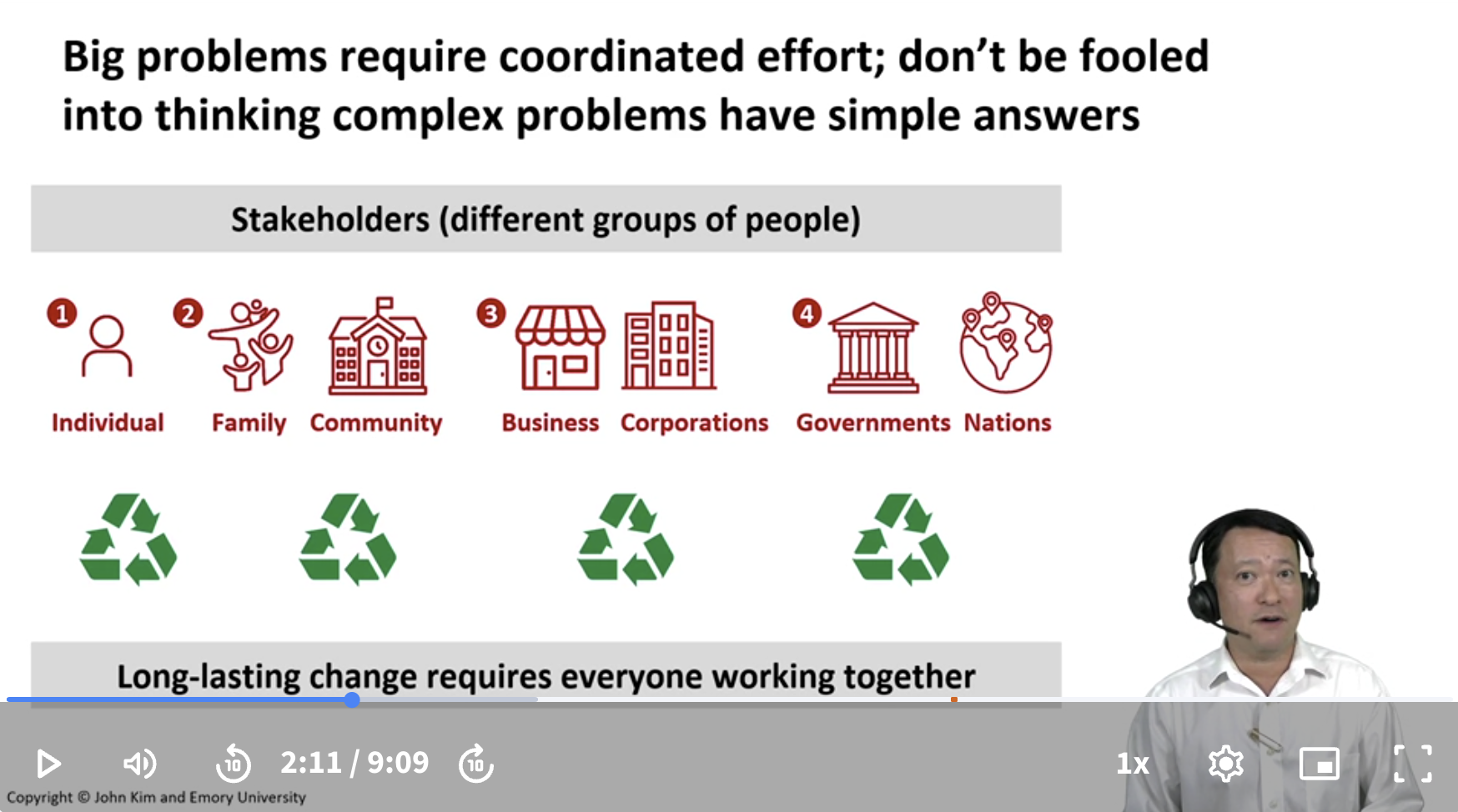
Big problems require coordinated effort; don’t be fooled into thinking complex problems have simple answers.
Stakeholders (different groups of people):
Individual, Family, Community; Business, Corporations; Governments, Nations
Long-lasting change requires everyone working together.
Big problems eg poverty, hunger, healthcare, climate change, etc. One person can’t solve these.
Instructor used to be more pro-free-market and skeptical of regulations. But now considers regulations to have an important role.
Eg: Consider recycling. As a citizen: I should not throw things away, dirty the river, etc. As a nation: There should be rules, there should be fines if people are behaving poorly. As a business: What this course generally focuses on.
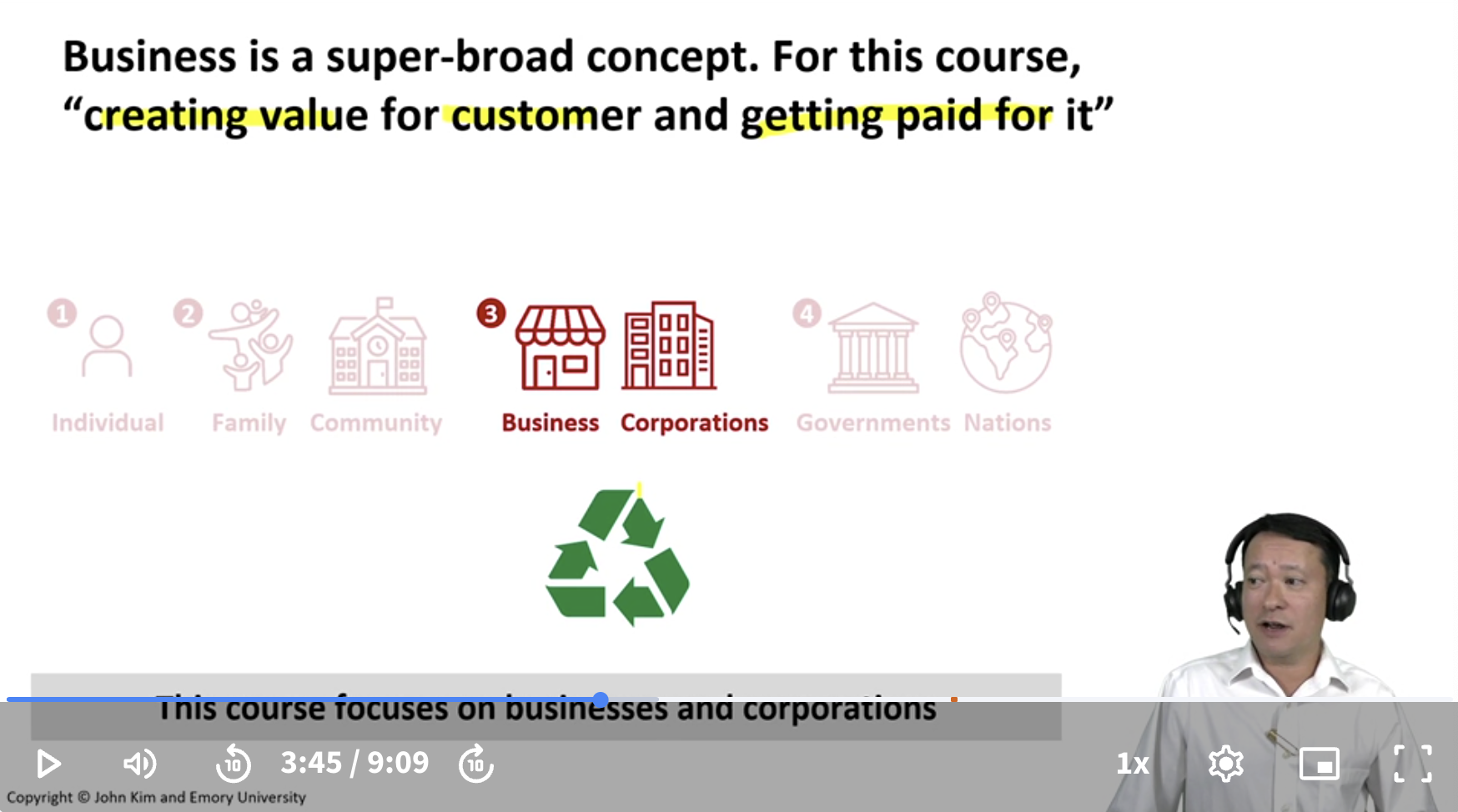
Business is a super-broad concept. For this course,
business = “creating value for customer and getting paid for it”
A business can be small, maybe a business of 1 person and
$ 0.5 Mdollars of sales. A business could be a massive corporation, with hundreds of billions of dollars of sales. There’s a huge spectrum.
Consider the role of businesses in recycling. Eg: Business that recycles aluminium cans. Eg: Business that innovates and finds a way to dispose off electric batteries used in BYD and Tesla cars in a very smart and efficient way.
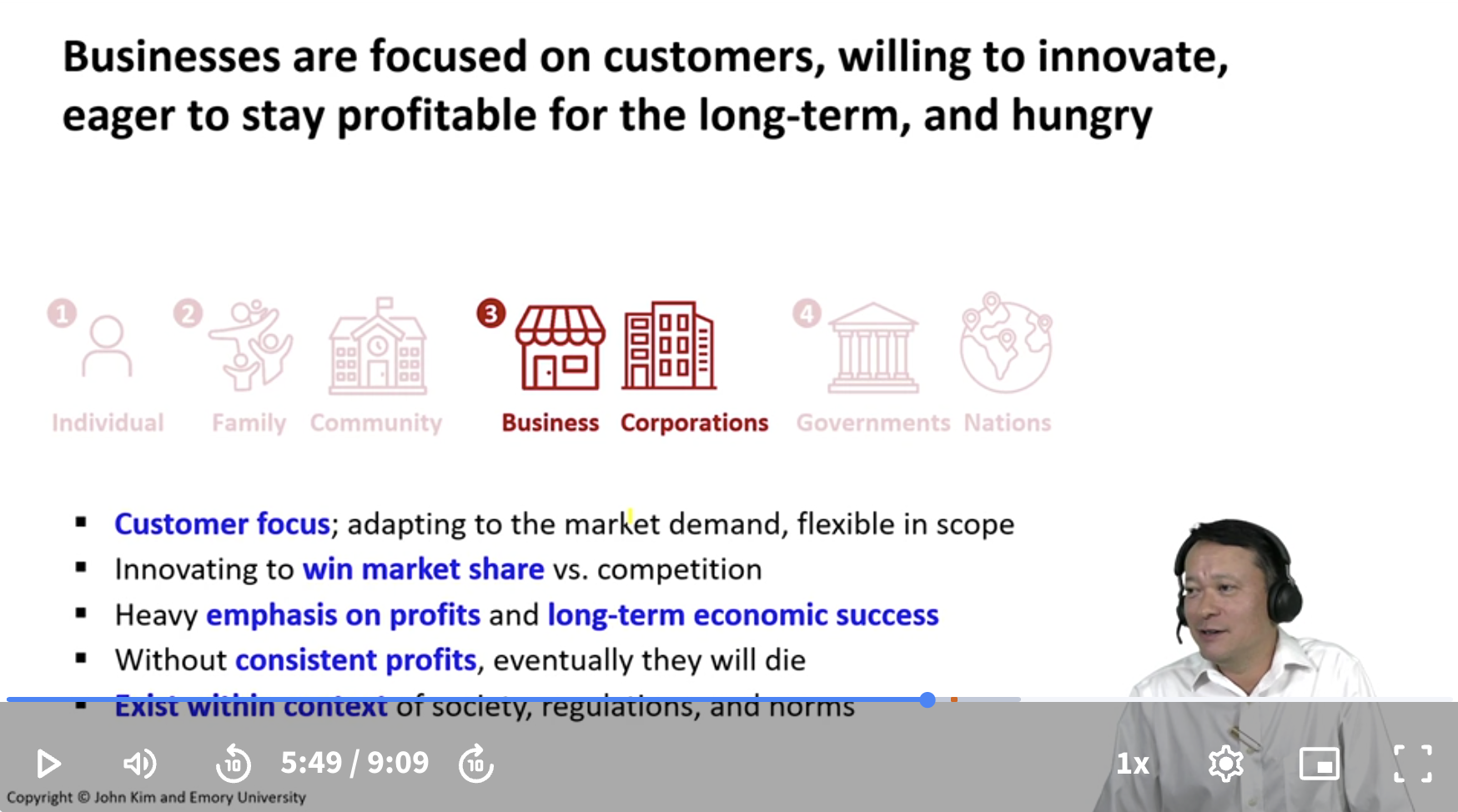
Businesses are focused on customers, willing to innovate, eager to stay profitable for the long-term, and hungry.
-
Customer focus; adapting to the market demand, flexible in scope.
-
Innovating to win market share vs competition.
-
Heavy emphasis on profits and long-term economic success.
-
Without consistent profits, eventually they will die.
-
Exist within context of society, regulations, and norms.
Eg: Instructor says: Right now, you’re watching Coursera. You’re my customer. I’m going to try different things. I’m going to move my hands. I’m going to talk loudly, be quiet. I’m going to try to create slides that are very effective. I’m going to hustle and try different ways to make you happy and have you watch more videos. That’s my goal.
Customer focus. Innovation. Emphasis on profits (it’s like oxygen). Exist within context.
Exist within contest: Honda (automobile company), someone mentions “We want to be a company that if we were to disappear, society would miss us”.
Businesses and companies want to hustle, change, innovate, earn your business, and also be profitable for the long term.
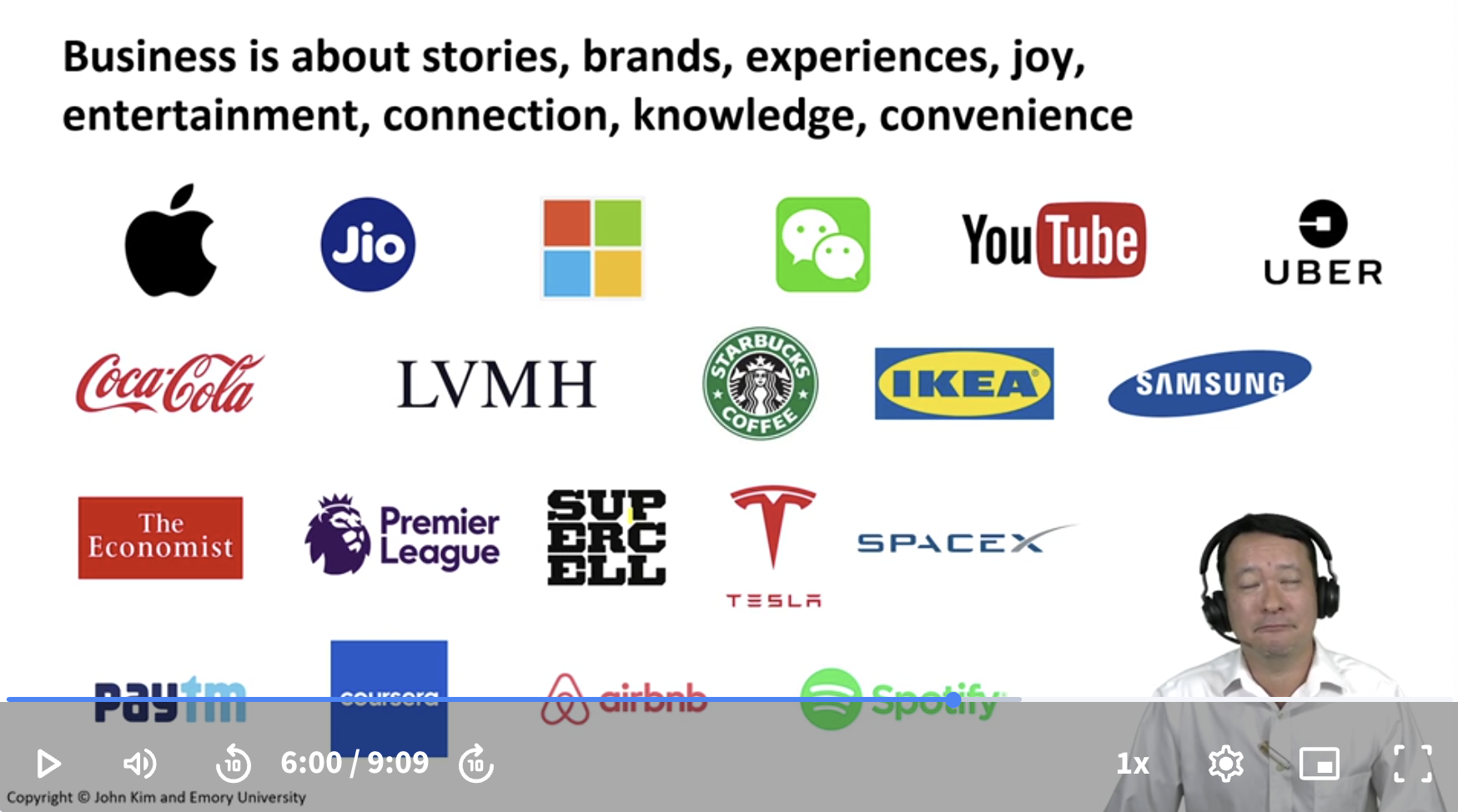
Business is about stories, brands, experiences, joy, entertainment, connection, knowledge, convenience.
Instructor: I thought about how can I get you excited about business. I thought what are some of the brands that I use that I love.
Instructor: I have an Apple iPhone and iPad. I use ChatGPT on Microsoft. I watch YouTube videos. I take Uber taxis. I’ve been reading The Economist for 30 years. I love watching Arsenal and Newcastle and Manchester City play football. There’s a game called Clash Royale that I play everyday, and it’s from a company called Supercell. Tesla, SpaceX are incredible. We did not see an electric car for 50 years. Then with Tesla, Elon Musk, we see that happen. I went to India this year, and you see QR based payment methods, apps like PayTM. It’s like Venmo in the US, but even better, even cheaper, even more efficient. Coursera, you’re enjoying it right now. Airbnb, we will talk about it. Spotify, I listen to Spotify every day.
Business can be fascinating. You start asking yourselves questions. How profitable is Airbnb? How does Spotify make money? What is Tesla’s profit margins compared to Hyundai?
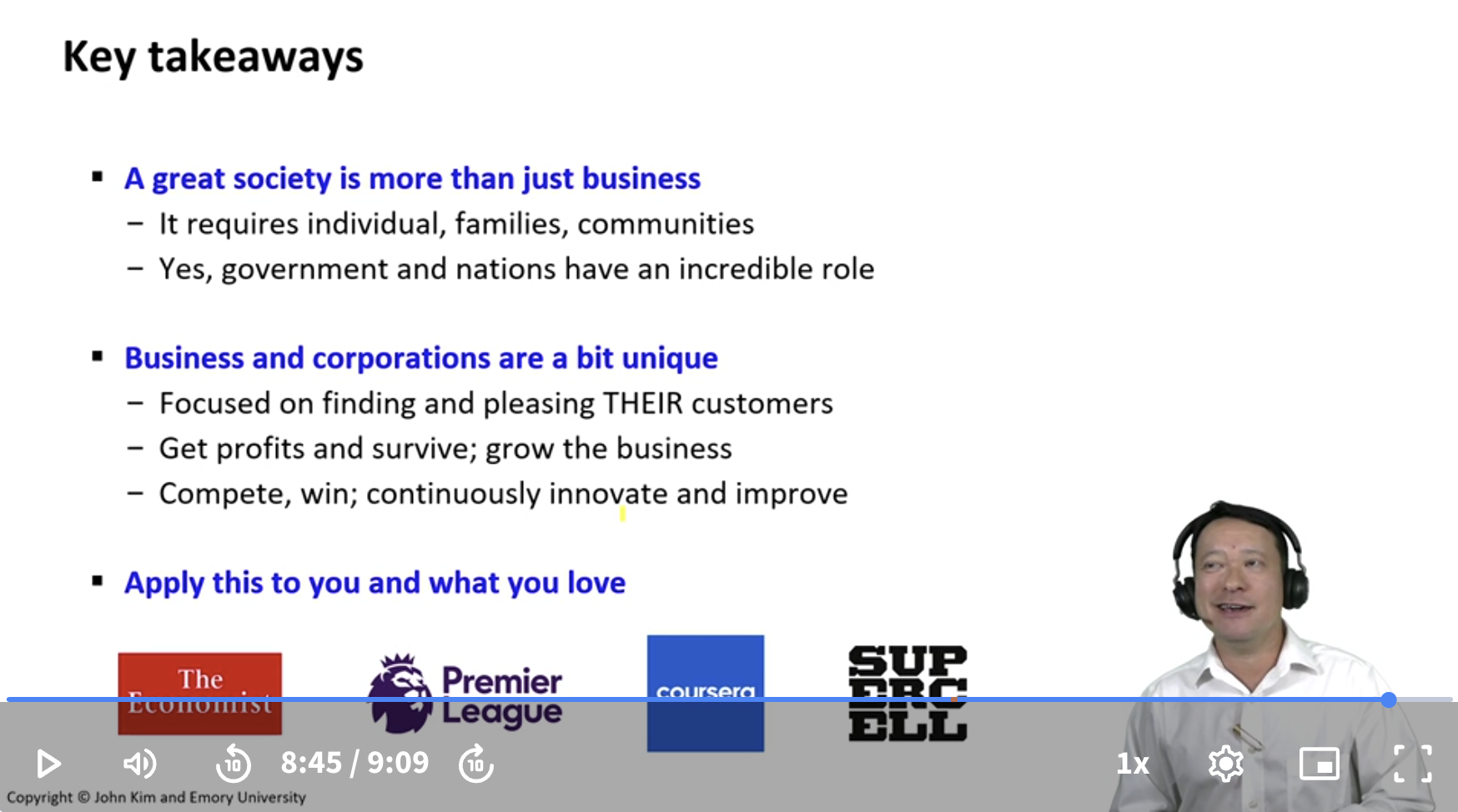
Key takeaways.
A great society is more than just business.
-
It requires individual, families, communities.
-
Yes, government and nations have an incredible role.
Business and corporations are a bit unique. (The focus in this course).
-
Focused on finding and pleasing THEIR customers.
-
Get profits and survive; grow the business.
-
Compete, win; continuously innovate and improve.
Apply this to you and what you love.
- Maybe The Economist, Premier League, Coursera, Supercell, etc.
Quote of the day
You don't understand anything until
you learn it more than in one way.

- Marvin Minsky.
[Why does “business” matter?]
This is for new graduates.
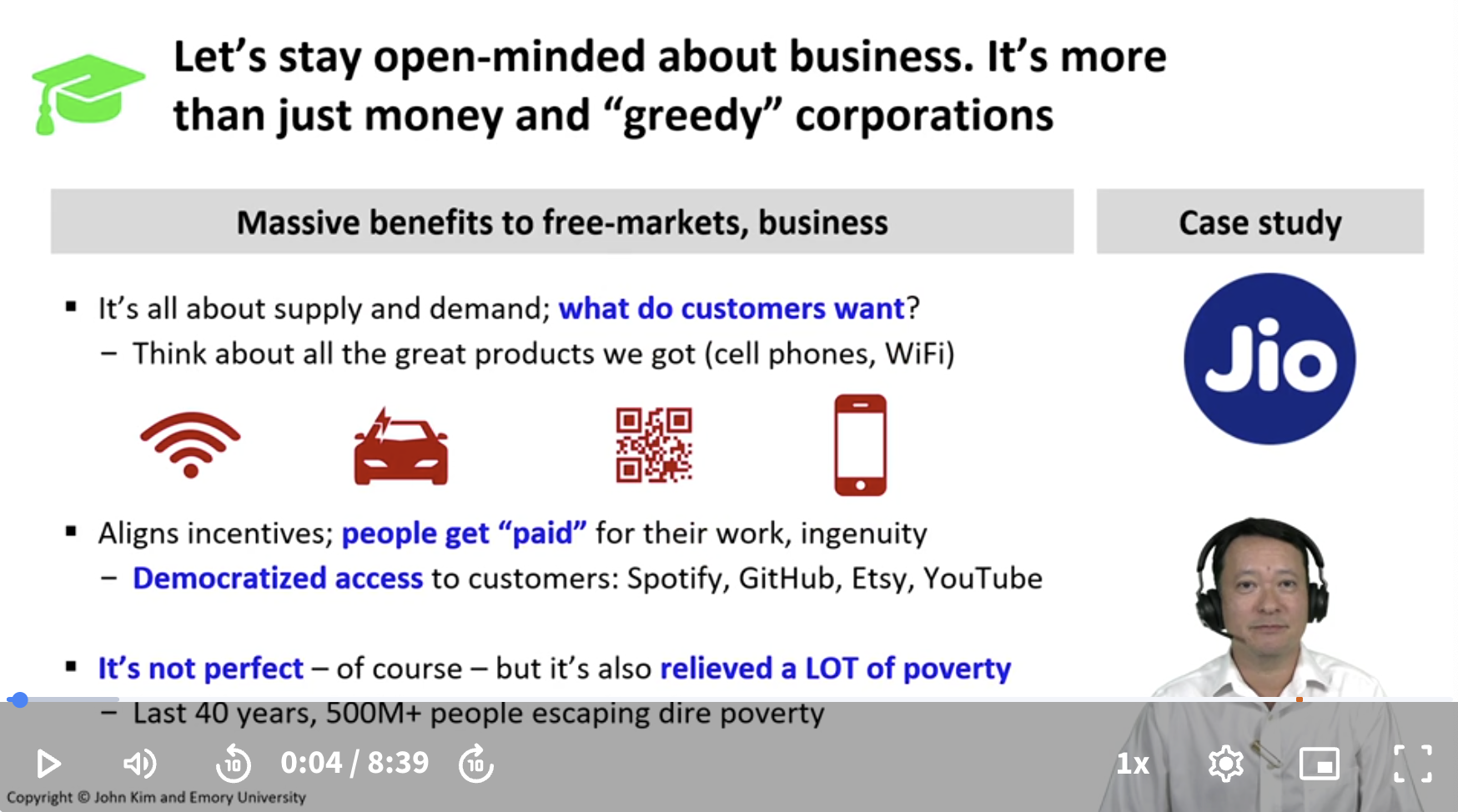
Let’s stay open minded about business. It’s more than just money and “greedy” corporations.
Instructor: Sometimes businesses get a bad reputation in the news. You hear about bad apples that steal money or they do these things that hurt customers. There are bad actors out there, no question, but that is a really rare situation.
Instructor: I’m going to give you several examples of why I feel that business is really a positive for society and therefore get you kind of excited about it.
Instructor: Benefits to free markets. Business is very customer focused. If there’s a lot of demand, you’re going to find that a lot of supply comes. For example, if people really want frozen yogurt and when frozen yogurt store opens, but there’s so much demand that there are people lining up, trust me, you will see another frozen yogurt shop open up right next door. It’s the idea that supply will find the demand.
Instructor: Innovation. Think about all the innovation and cool products that we have. (Like we saw earlier). It’s easy to take a lot of that for granted.
Instructor: Win-win. Business tends to align incentives. Companies want to innovate, earn your business so they can get paid. It’s a win-win. (Win-win is an important concept in business. As graduates, when you are interviewing at a company, think about the business at there, and what does the win-win look like for them? As a manager a lot of times, you’ll have a boss. What’s a win-win for you and them? As an entrepreneur, same thing).
Instructor: Democratized access. There’s never been a better time for you to be a business owner. It’s a very democratized access. If you play guitar very well and you’re a great singer, you can upload things to Spotify. You can put it on Instagram. You can put it on YouTube. You can become famous. If you’re good at Python and you use ChatGPT and you’ve created really good code, you can put it on GitHub and become famous. It’s never been easier for you as a creator to put content up there. Think about me. I’m a faculty member at Emory, but one of hundreds, but if I’m good at it, I can package this up, put it on Coursera, and then you can enjoy this no matter where you live, Indonesia, Iceland, or India.
Instructor: Alleviating poverty. My undergraduate major was international relations, so I would study the development of economies and things like that. For most of history, everybody was really poor. For just thousands of years, everybody was poor. Over the last 40 years, with the real mega trend of free markets, especially in China and India, we have seen, by some estimates, 500 million people escape really the worst kind of poverty. That’s a half a billion people who are healthier, and they’re feeding their sons and daughters, and they’re making a good life for themselves, so even that alone, we should clap, right and be happy about that.
Instructor: Case study - Jio. Over the last maybe 5 or 6 years, Reliance. (It’s like General Electric in the US, or Samsung, Hyundai in Korea, one of the really big conglomerates in India). They decided to invest in 4G technology. I think they spent about
$ 30 billion, put up cell towers, and created very low-cost phones, and even gave away Internet data packages for free. They took some risk developing the phone, distributing it, creating the cellphone towers. The net result of it is maybe 300 million Indians, especially those who live in the rural parts of India, are now online. You have grandmas and grandpas who maybe they don’t even know how to really read or even write formally and yet they’re able voice or text. Maybe they can check the prices of the onions and the potatoes that they farm. Basically it democratized access to Internet for 300 million people, that’s incredible.
Instructor: Many businesses. We’re going to talk about all different kinds of companies, and some are doing really great work for society, and some are just creating video games to keep us entertained. What I would argue is that with business, they are trying very hard to keep you happy as a customer, and that is a win-win for everybody.
Massive benefits to free markets, business.
1 It’s all about supply and demand; what do customers want?
- Think about all the great products we got (cell phones, WiFi).
2 Align incentives; people get “paid” for their work, ingenuity.
- Democratized access to customers: Spotify, GitHub, Etsy, Youtube.
3 It’s not perfect - of course - but it’s also relieved a LOT of poverty.
- Last 40 years, 500M+ people escaping dire poverty.
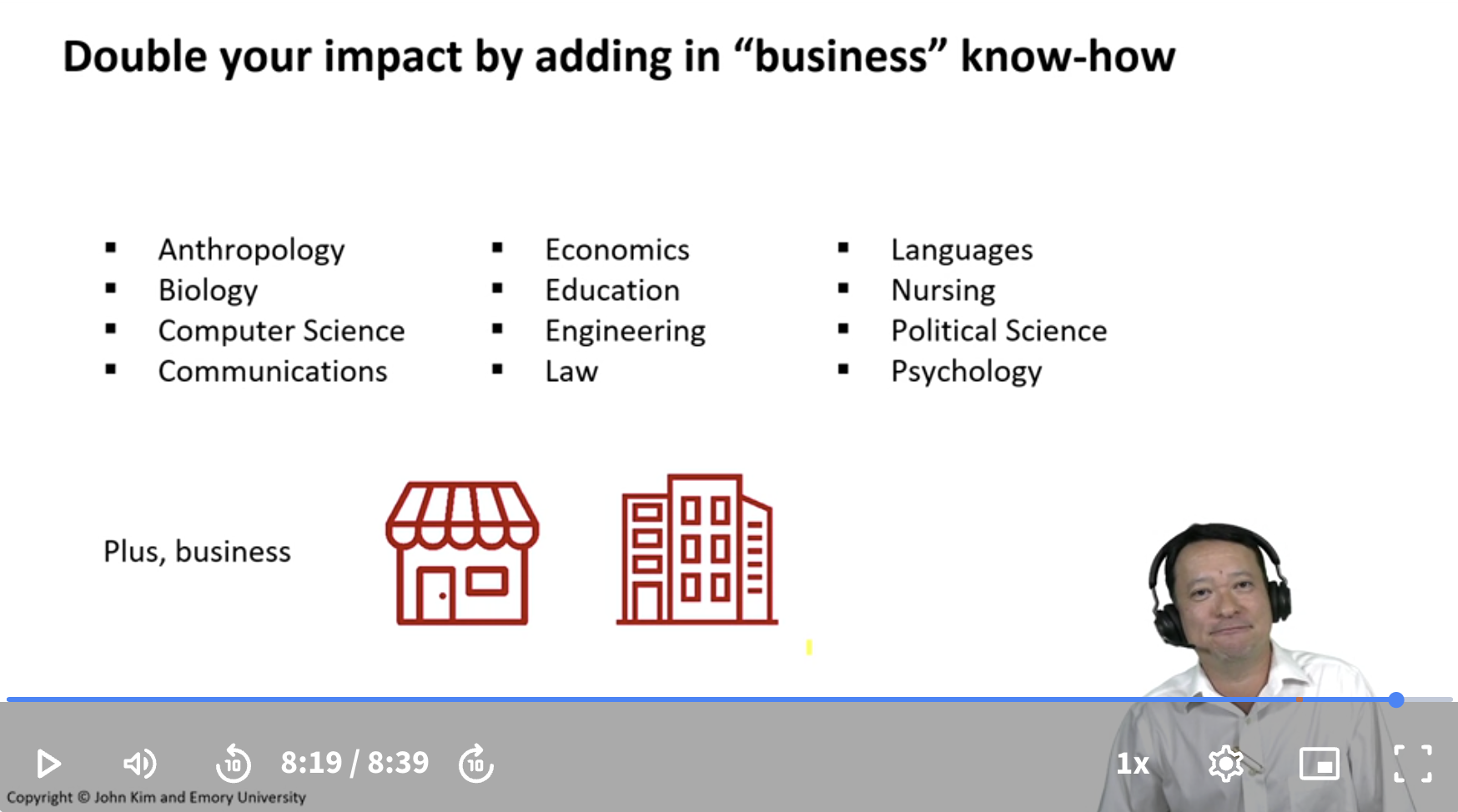
Double your impact by adding in “business” know-how
Graduates you may have studied any subject. Maybe you studied:
Anthropology, Biology, Computer Science, Communications, Economics, Education, Engineering, Law, Languages, Nursing, Political Science, Psychology
Adding a little bit of business is like putting salt on your food. It makes it taste better.
Personal: As a math grad, maybe engaging with math can be made more gamified and socialised than it is now. It might be a good thing to have.
Personal: Some current examples at school level include MathCounts, Math Clubs, AoPS FTW, there used to be Math Fights. I remember learning calculus on a game like android app as well, I don’t remember it’s name. Some current examples at uni level include Math Stackexchange, Math Overflow, etc.
Personal: Inquiry based Learning in Mathematics has already gained some traction. MathOverflow post: Link.
Personal: Maybe AI can be integrated as well.
Quote of the day
Forever is composed of nows.

- Emily Dickinson.
[Narayana Health - Successful Indian health system]
Website: https://www.narayanahealth.org/.
Narayana Health is a publicly-traded set of hospitals, based in India, and founded by Dr. Devi Shetty - the cardiac surgeon to Mother Teresa. They pioneered a high-quality, extremely efficient, and less expensive way to treat patients.
Case study: Link.
From the case study: Around the time Narayana Health was founded, approximately 2,400,000 Indians required heart surgery annually, but prohibitive costs and a shortage of providers meant only 60,000 recieved it.
Instructor: It’s almost unbelievable, but they have quality for CABG (heart surgery) in par with the United States, but at less than 1/10 the cost. . . Incredible value (saving someone’s life) and a low cost (1/10th of the US). It’s a remarkable story of strategy, vision, leadership, and operational efficiency.
Finally, the health system is publicly-traded on the Bombay stock exchange because the founder says, “Charity is not scalable, whereas good business principles are.” He also said, “ If all the money in the world is pooled together, it will not be sufficient to fund healthcare for all citizens of the world for a year.”
[Pareto Principle. The 80/20 rule]
The Instructor mentions he believes in the 80/20 rule.
Videos on the 80/20 rule of thumb: Link, Link, Link.
As per the Sprouts video:
The 80/20 rule of thumb:
Often 20 % of the causes create around 80 % of the outcomes. (The remaining causes are responsible for the rest).
Pareto observed:
-
20 %of the pea pods in his garden were responsible for80 %of the peas. (This is unintuitive). -
80 %of all the land in Italy was owned by20 %of it’s people.
It’s a useful rule of thumb.
Example:
-
Business owners often realise about
80 %of a company’s income comes from20 %of the customers. (And as a result know who to give special attention to). -
Constructors who find out that
20 %of the hazards result in80 %of the injuries can take important precautions to eliminate risks. -
Software engineers who know that fixing the important
20 %of the most reported bugs eradicates80 %of the errors can spend their time on the important20 %first.
Likewise for wealth.
Pareto also warns people about relying too much on the principle.
To do: A heuristic proof for the 80/20 rule. There seem to be some toy-economy simulations which validate this rule, like in the MindYourDecisions video and Jordan Peterson video.
Intuition: Pareto distribution seems to appear in phenomena where: An object already having more of a property P is more likely to further accumulate property P. Like the “Rich get richer, poor get poorer” phenomenon we tend to see. Have to think about this.
[Module 2 Intro]
[Profits are oxygen; it keeps the business alive]
One of the simplest ways to think about profits is something called the value stack. Graphically, it looks like 3 Legos stacked on top of each other. The value stack looks simple, but it is crazy useful. It helps to visualize marketing, strategy, and pricing. You will see if used often in this specialization.
[Value stack = willingness to pay, price, cost]
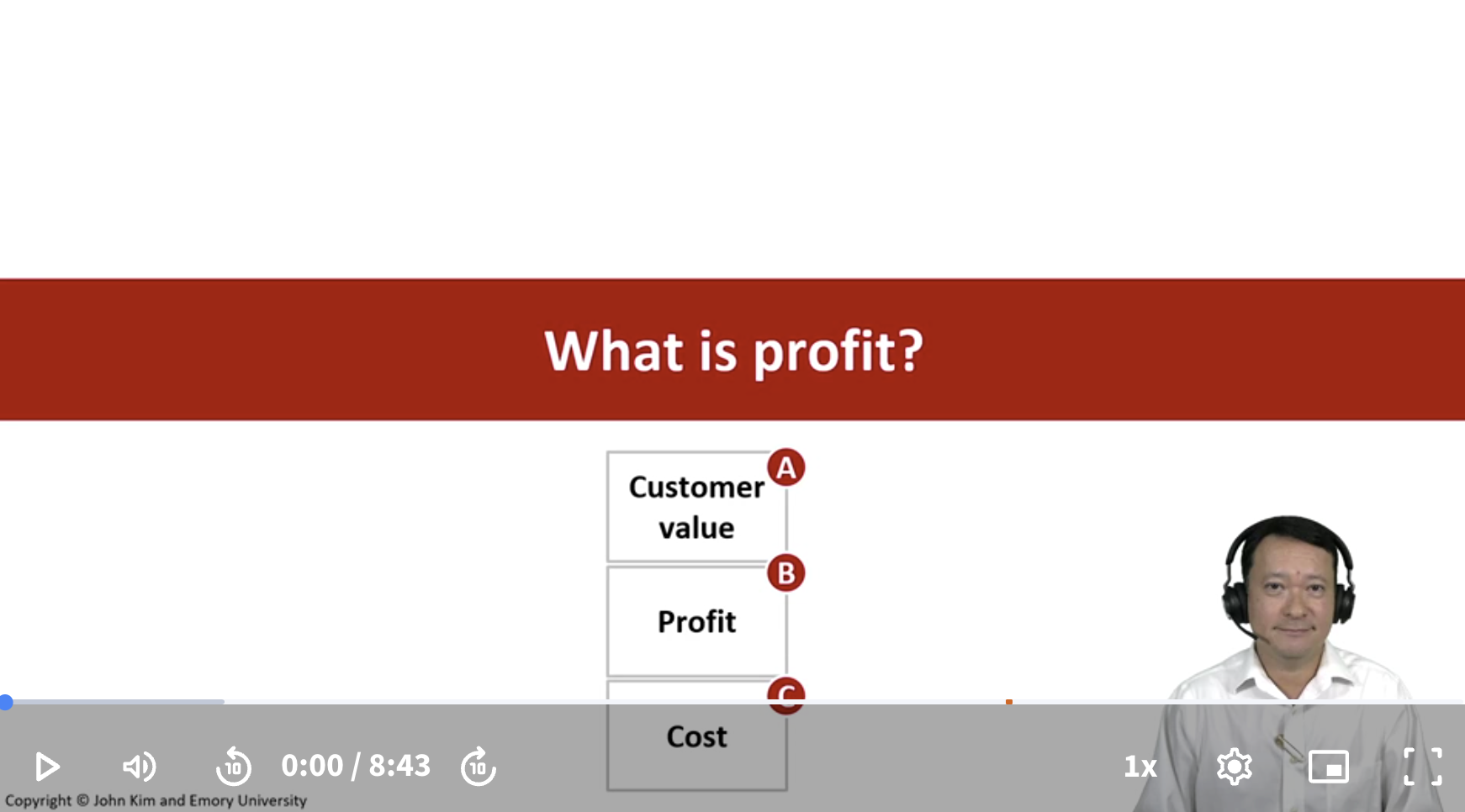
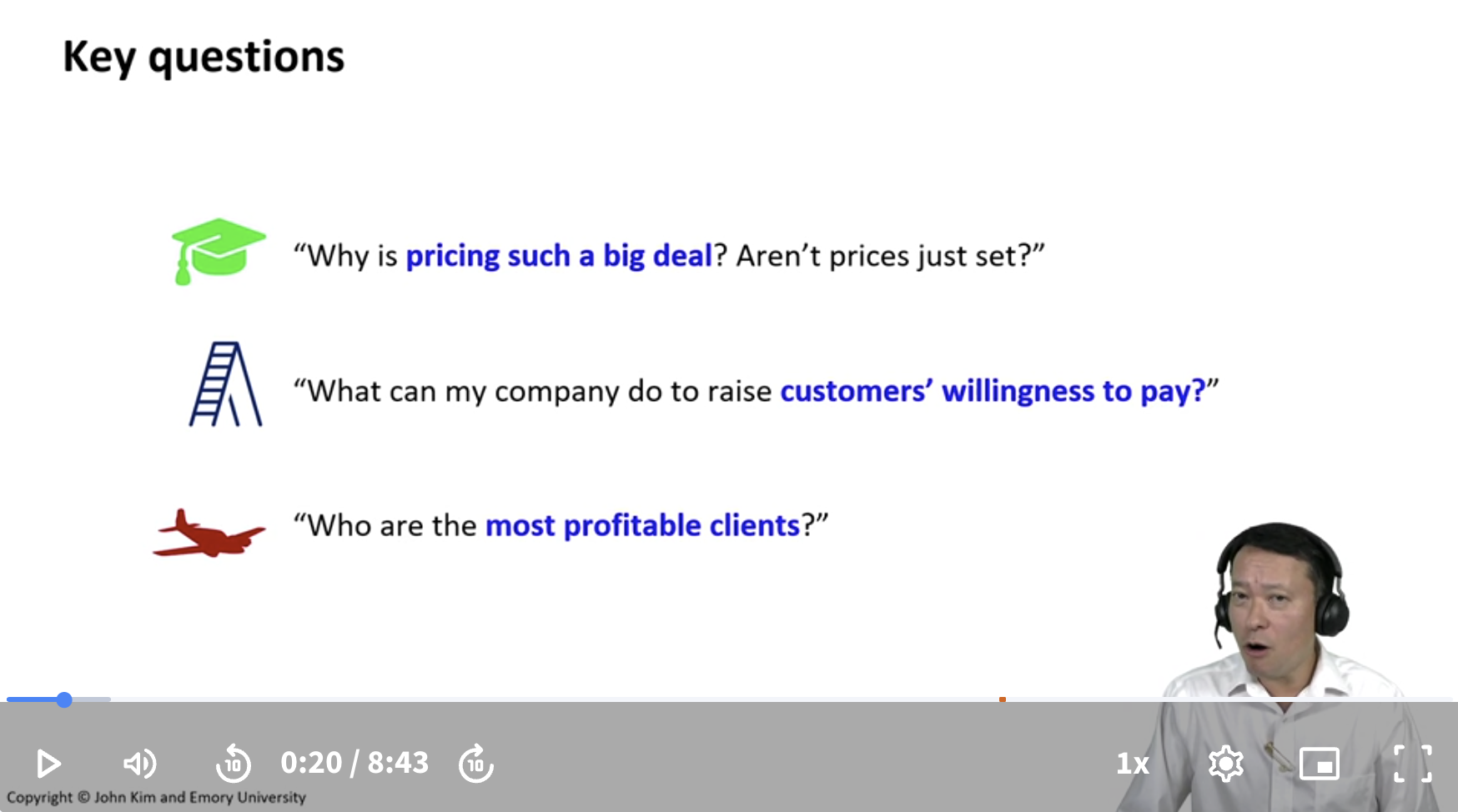
Some questions which one might ask.
Graduate: “Why is pricing such a big deal? Aren’t prices just set?”
Manager: “What can my company do to raise customers’ willingness to pay?”
Entrepreneur: “Who are the most profitable clients?”
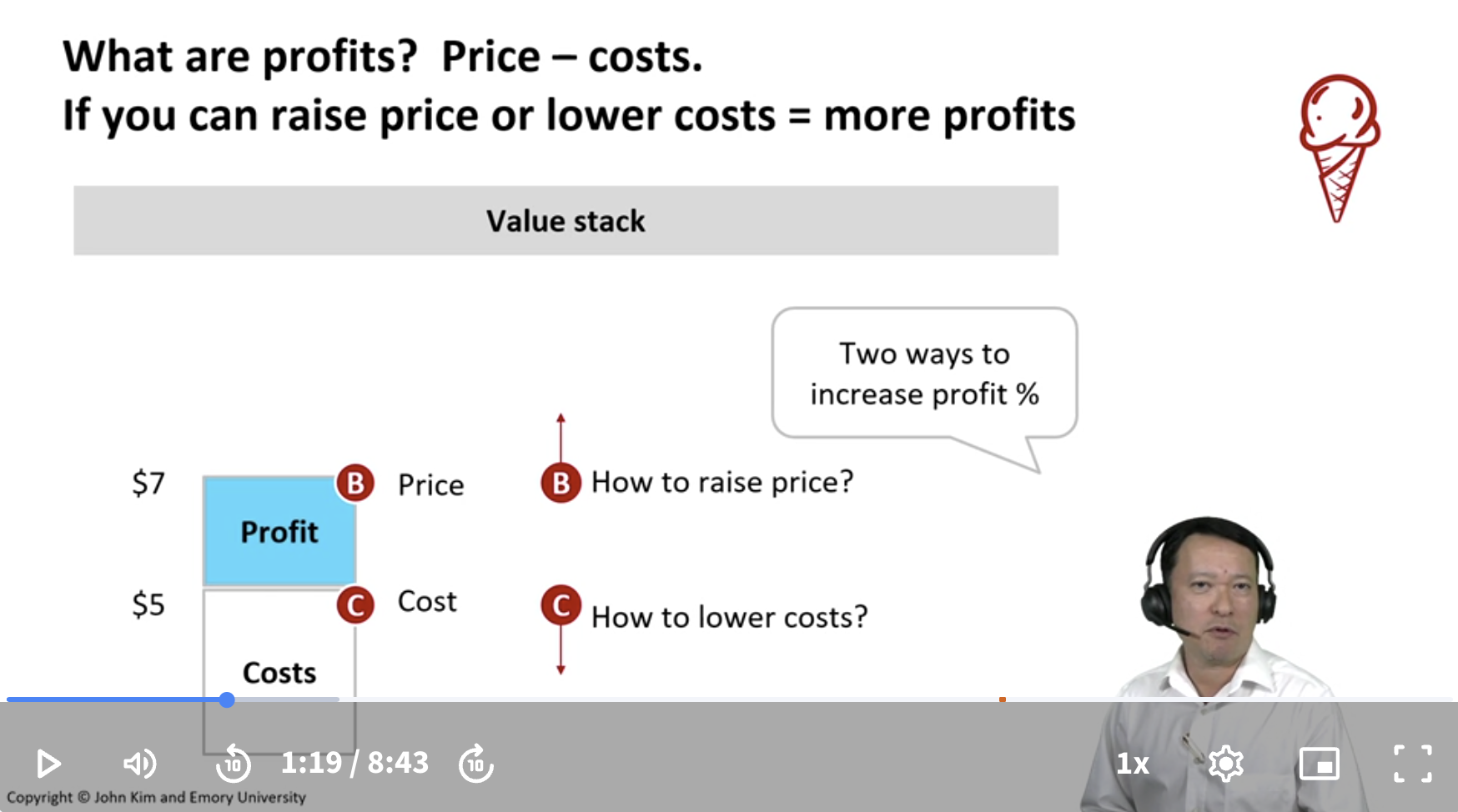
What are profits? Price - costs.
If you can raise price or lower costs = more profits.
(Personal: This taken at face value like a math result seems wrong. If one for eg raises price too much and lowers cost too much, it causes supply-demand fluctuation and business might tank. Ok this is addressed in the next slide)
Instructor: Pricing. Why is pricing such a big deal? What can I do if I work in a company to either raise price or lower cost to be more profitable? Then as a entrepreneur, who are my most profitable customers?
Instructor: You might be selling an ice cream cone, and your costs are
$ 5per cone. That includes, the cone, the ice cream, even the employee that serves it to your customers. It might even be for the shop, you’re paying rent. Suppose you are selling at$ 7per cone to your customer. You have$ 7 - $ 5 = $ 2profit. Super simple so far.
Why not price the ice cream at $ 8 or $ 9 or higher?
Good thing = profit. Bad thing = lower ice cream sales.
More profit per ice cream cone. Less number of sales.
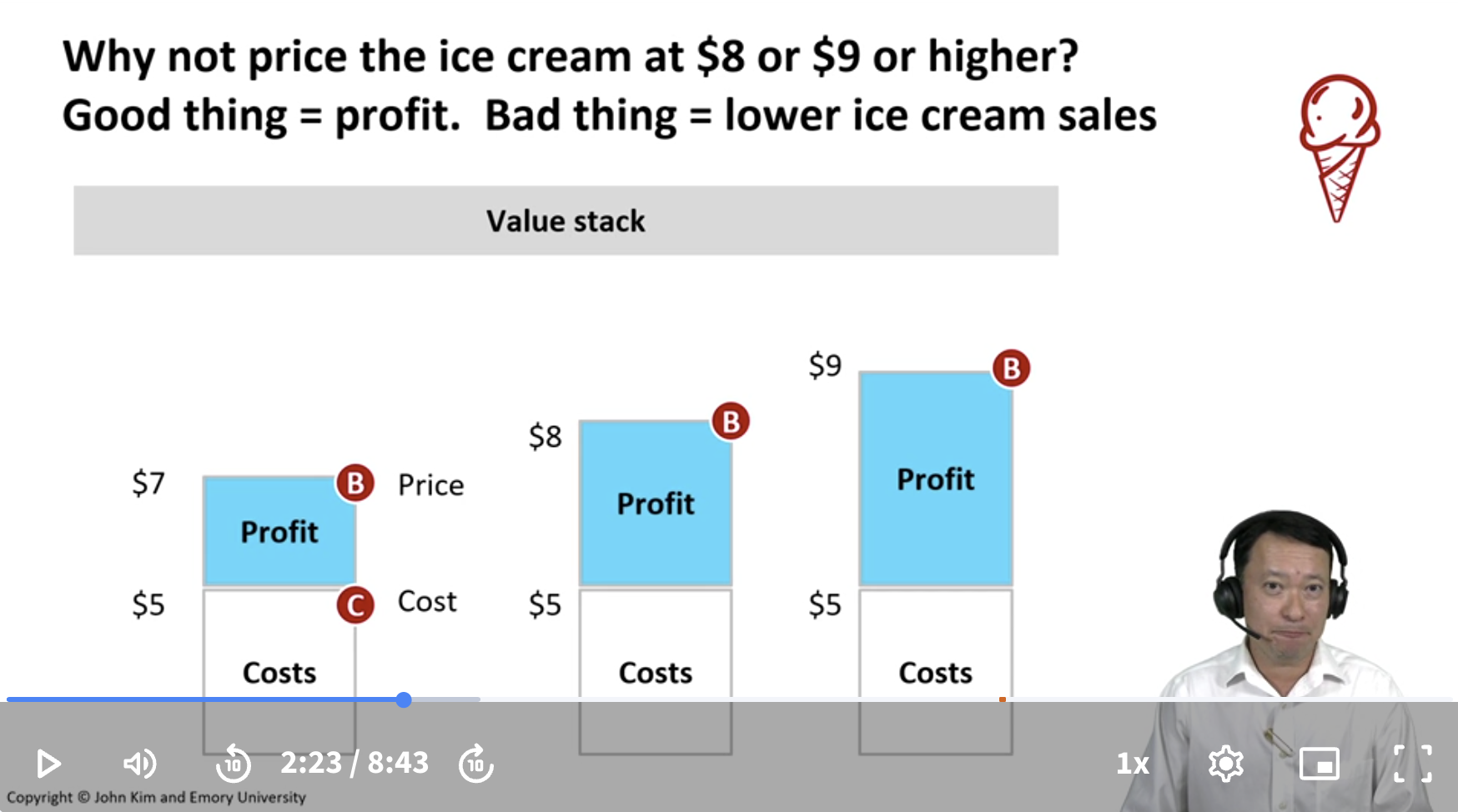
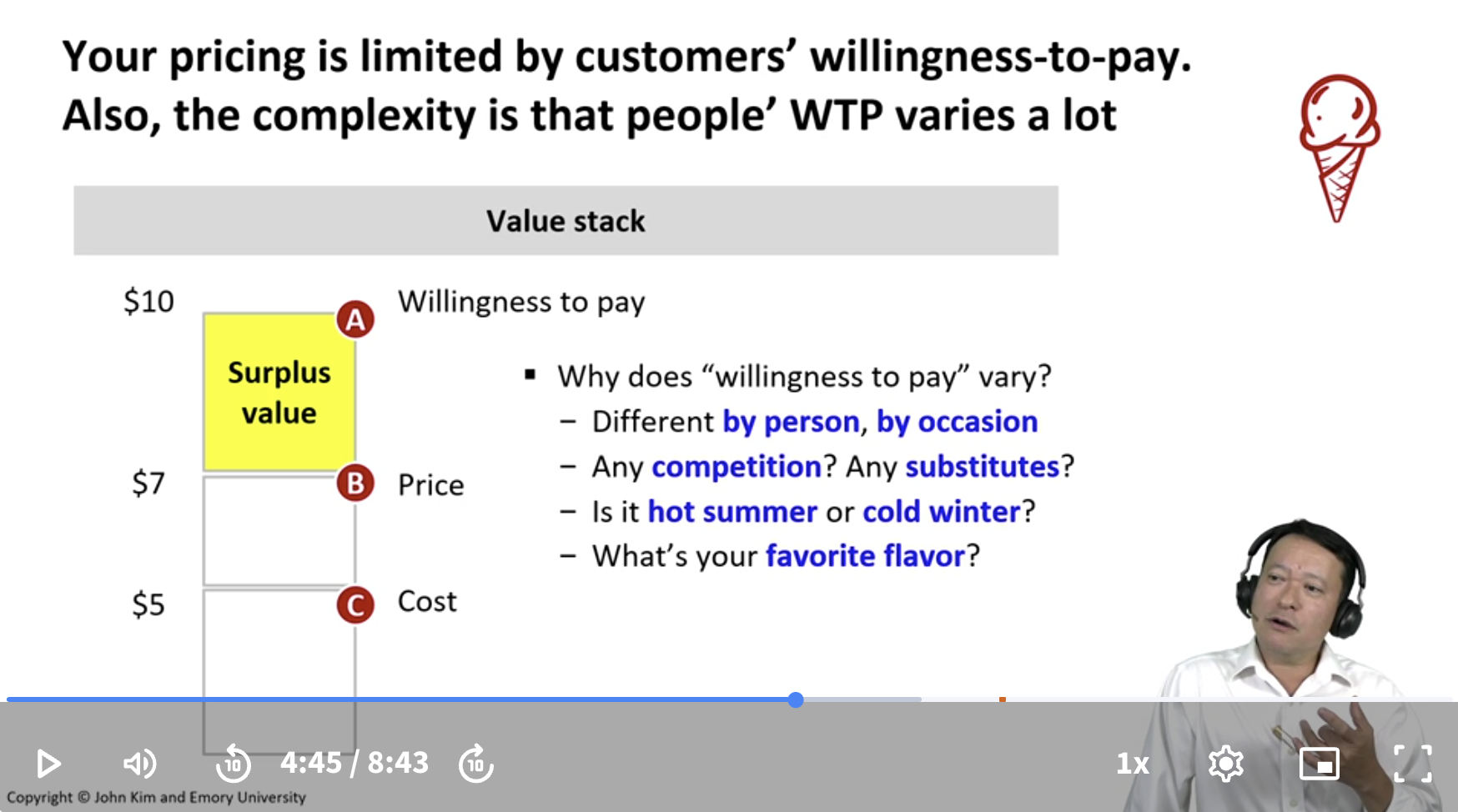
Your pricing is limited by customers’ willingness-to-pay.
Also, the complexity is that people’s WTP varies a lot.
Why does “willingness to pay” vary?
-
Different by person, by occasion.
-
Any competition? Any substitutes?
-
Is it hot summer or cold winter?
-
What’s your favorite flavor?
Instructor: Cost, Price, Willingness to pay. These determine how much value there is, how much value they’re going to keep the customer, and how much value you’re going to keep as profit.
Instructor: Willingness to pay is hard to determine. Depends on kind of person, occasion, competition, etc.
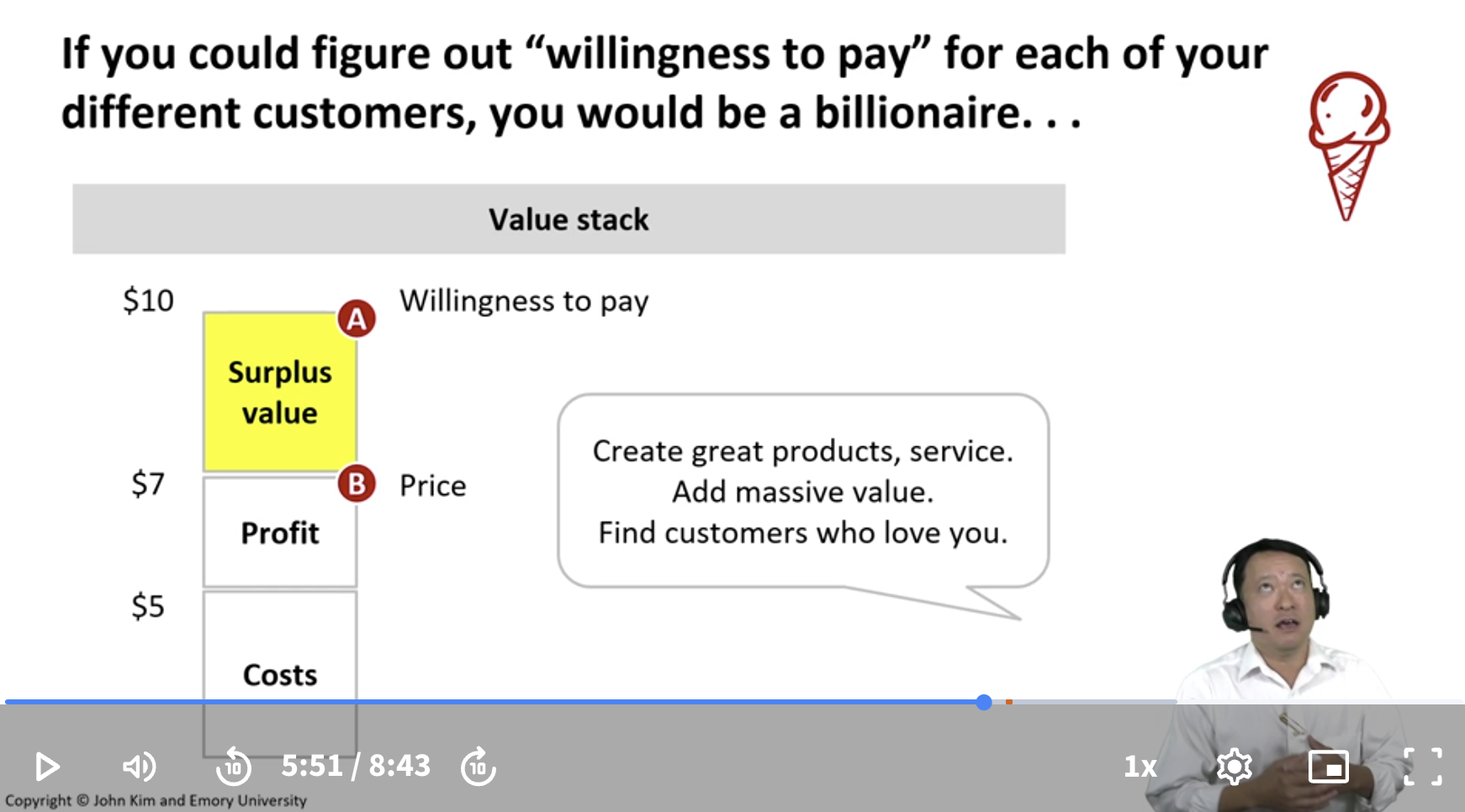
If you could figure out “willingness to pay” for each of your different customers, you would be a billionaire…
Instructor: Figuring out the WTPs is difficult. The simpler answer is, as a business person, you need to create as much value as possible. If you can raise the willingness to pay as high as possible, then you have more capability to price before somebody says no.
Instructor: ChatGPT exercise. How is the pricing strategy different for these companies? Louis Vuitton and Hermes. They’re both very expensive luxury brands.
Instructor: From my perspective they’re both luxury. But their pricing strategy is quite different. Other egs: Pricing strategy of Nike vs Supreme, Pricing strategy of Costco vs Walmart, etc. There is a lot of art and science in pricing.
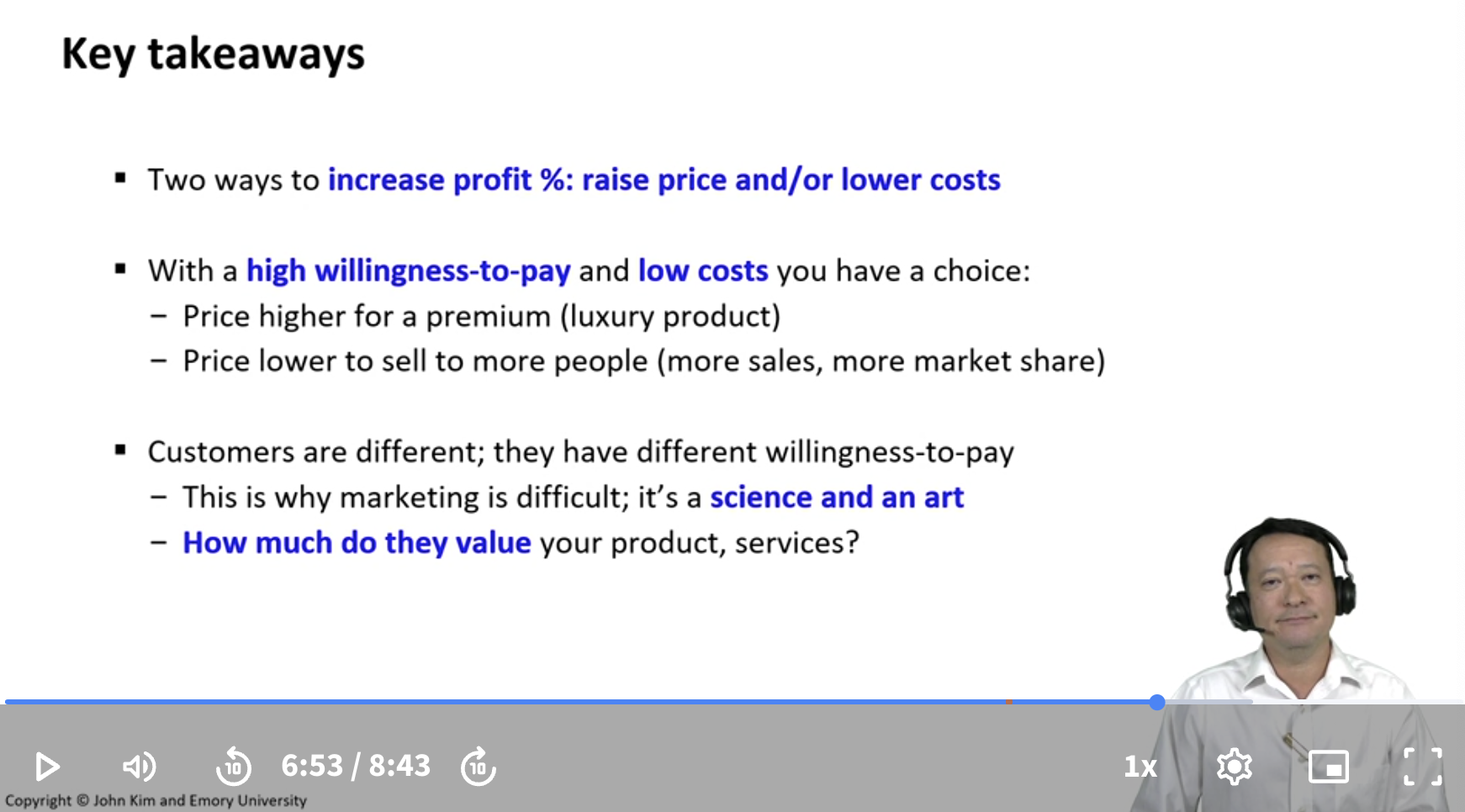
Key takeaways
Two ways to increase profit %: raise price and/or lower costs.
With a high willingness to pay and low costs you have a choice:
-
Price higher for a premium (luxury product).
-
Price lower to sell to more people (more sales, more market share).
Customers are different; they have different willingness to pay.
-
This is why marketing is difficult; it’s a science and an art.
-
How much do they value your product, services?
Opinion/Intuition: Suppose one has high WTP and low costs. Sort of doing the price lower to sell to more people does more good? For eg, Coursera seems like a good example, of a company sort of doing this.
Quote of the day:
The worst crime against working people
is a company which fails to make a profit.

- Samuel Gompers
(Gompers was a union leader. Fascinatingly he was a very practical person).
[Why is value so subjective?]
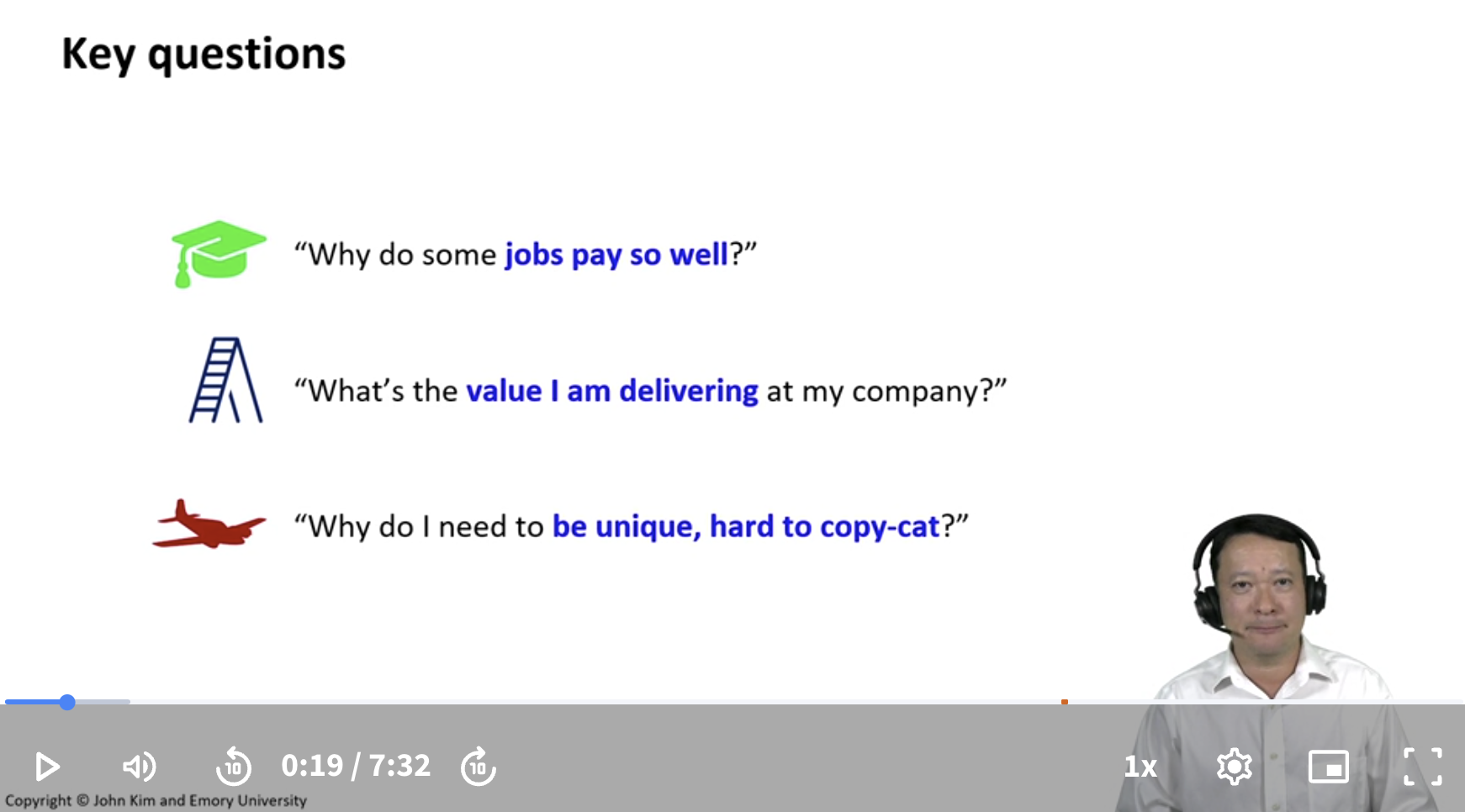
Key questions which one might ask.
Graduate: “Why do some jobs pay so well?”
Manager: “What’s the value I am delivering at my company?”
Entrepreneur: “Why do I need to be unique, hard to copy-cat?”
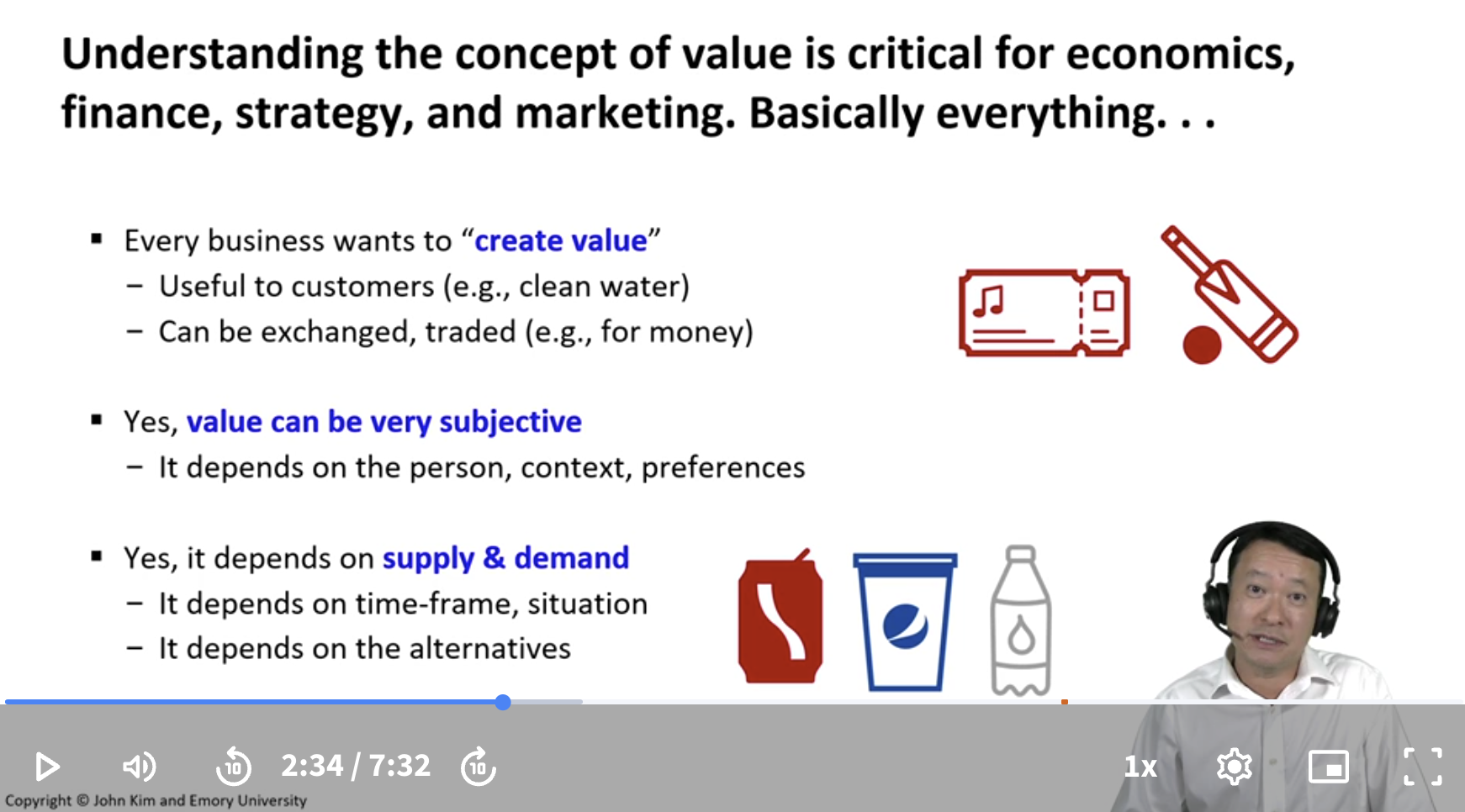
Understanding the concept of value is critical for economics, finance, strategy, and marketing. Basically everything…
Every business wants to “create value”.
-
Useful to customers (eg, clean water).
-
Can be exchanged, traded (eg, for money).
Yes, value can be very subjective.
- It depends on the person, context, preferences.
Yes, it depends on supply and demand.
-
It depends on time frame, situation.
-
It depends on the alternatives.
Instructor: Value is subjective. Maybe there’s 1,000 people watching these videos, and all of us have different interests and things that we like. One person might really enjoy going to a music concert, while the other person would prefer to go to a cricket match.
Instructor: Value is influenced by situations. Like we discussed value and willingness to pay can vary by situation (eg, ice cream on a hot day vs on a cold day).
Instructor: Value is influenced by supply and demand. Consider the beverages in the picture. So the red can, maybe you really want to drink that, and the value that you associate with that, would be higher if there’s no other choices, say you go to a building and there’s only one kind of drink that you can purchase. Well, I’m thirsty. It’s valuable. But if I go into a building and there’s a red machine, a blue machine, and also a water machine, and I have lots of choices. Then all of a sudden, depending on the supply and demand, my sense of value might differ.
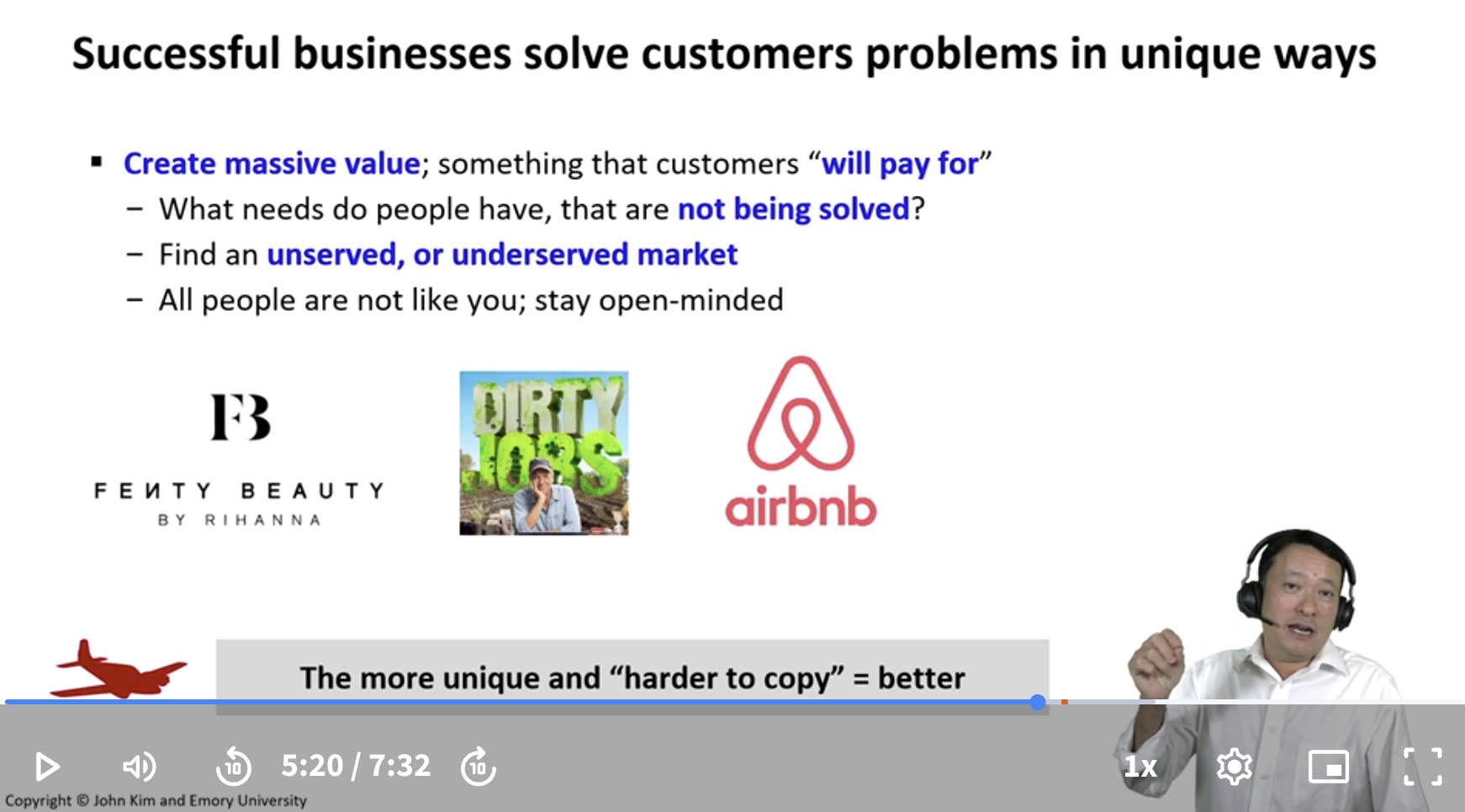
Successful businesses solve customers problems in unique ways
Create massive value; something that customers “will pay for”.
-
What needs do people have, that are not being solved?
-
Find an unserved, or underserved market.
-
All people are not like you; stay open-minded.
Eg: Underserved/Unserved market. Fenty by Rihanna. It is a cosmetic brand where they were able to match the skin tones of people who weren’t being addressed in the market. A lot of the skin colors that were available didn’t match what people needed. So Rihanna smartly said, hey, we can do better than that.
Eg: Underserved/Unserved market. Dirty Jobs, a TV show. The host Mike Rowe goes around the United States, and he finds people who are making very good money doing dirty things, cleaning out this, doing that. Things that are very unconventional. And some people might think, you know, very blue collar and not cool, not fun, right? But note: for a lot of the things that people don’t want to do, somebody needs to do, and because nobody is doing that, there’s a lot of demand. High demand, low supply means higher price.
Eg: Underserved/Unserved market. Airbnb. Suppose I’m going to go travel with my family, and I want to have a kitchen so I can cook, you know, delicious Korean food for dinner. Well, a lot of hotels don’t offer that. And so all of a sudden, we’re matching up supply with demand.
For entrepreneurs: The more unique and “harder to copy” = better.
Instructor: If you’re doing something that is very easy to copy, you might make money in the short term, but in the long term, other people are going to copycat you and take your profits away.
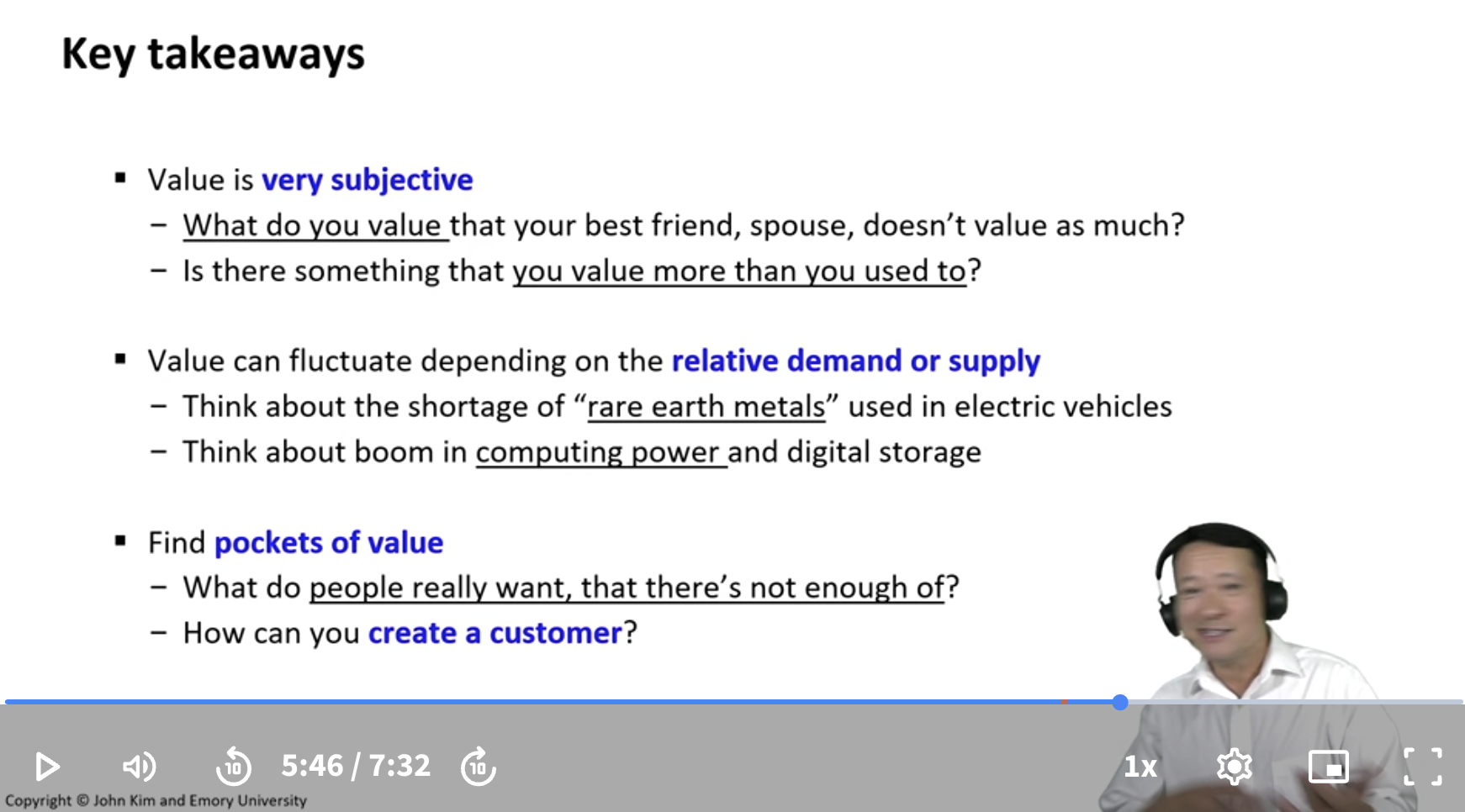
Key takeaways
Value is very subjective.
-
What do you value that your best friend, spouse, doesn’t value as much?
-
Is there something that you value more than you used to?
Value can fluctuate depending on the relative demand or supply.
-
Think about the shortage of “rare earth metals” used in electric vehicles.
-
Think about boom in computing power and digital storage.
Find pockets of value.
-
What do people really want, that there’s not enough of?
-
How can you create a customer?
Instructor: If you can find something that people want and there’s not enough of, that’s a recipe for success. One example, when I was thinking about putting together a coursera specialization on management consulting, I went to coursera and I typed in management consulting. And there were a couple of courses here and there, but it wasn’t part perfect and so for me, I realized, I’ve got experience in consulting, I love talking about it, I’ve been blogging about it for 13 years. Why don’t I create a coursera specialization on management consulting, there’s high demand and low supply? I’m creating a lot of value for people.
Quote of the day
Price is what you pay.
Value is what you get.

- Warren Buffet
[Eg: LVMH luxury 2024 financial results]
Business is diverse. It includes the most basic things (e.g., food, water, houses, safety) to extremely luxurious items like perfume, sportscars, and $10,000+ handbags. As an executive, it’s useful to see these decisions through the lens of willingness to pay, price, cost.
LVMH has 84 billion Euro in revenue, and almost 20 billion in profits. So their net margin % is about 20%… that’s amazing. Is it because they have low costs? No, it’s because their customers have a massive willingness to pay.
Link to the report: Link.
[Personal]
Personal: It seems both the extremes:
-
A high quality product/service with low affordability
-
A low quality product/service with high affordability
produce less value to people.
(The other two combinations seem to be:
High quality, high affordability - a dream.
Low quality, low affordability - a scam).
A decent quality, affordable, scalable product/service might produce a lot of value.
Optimizing business workflows might help in this matter.
Personal: One problem society seems to face is, value creation, “earning one’s place in society”, seems difficult. Blogpost: Link.
Personal: The tendency for the rich to get richer and the poor to get poorer also seems to be a problem. With the current economic structure, wealth seems to follow a pareto distribution. Veritasium video: Link.
[Module 3 Intro]
[Supply chain is heavy = factories, warehouses, trains, ships, trucks]
In the digital world we live in, it’s easy to forget that products take a long journey to get to us. Whenever you see a truck, train, plane, delivery van, retail store, or package = that’s the supply chain. “Process flows” are a simple tool to chronologically visualize how the products get designed, manufactured, and distributed. For example, a comfortable pair of blue jeans might travel 10,000 km as it gets transformed from raw materials (cotton) into the final product.
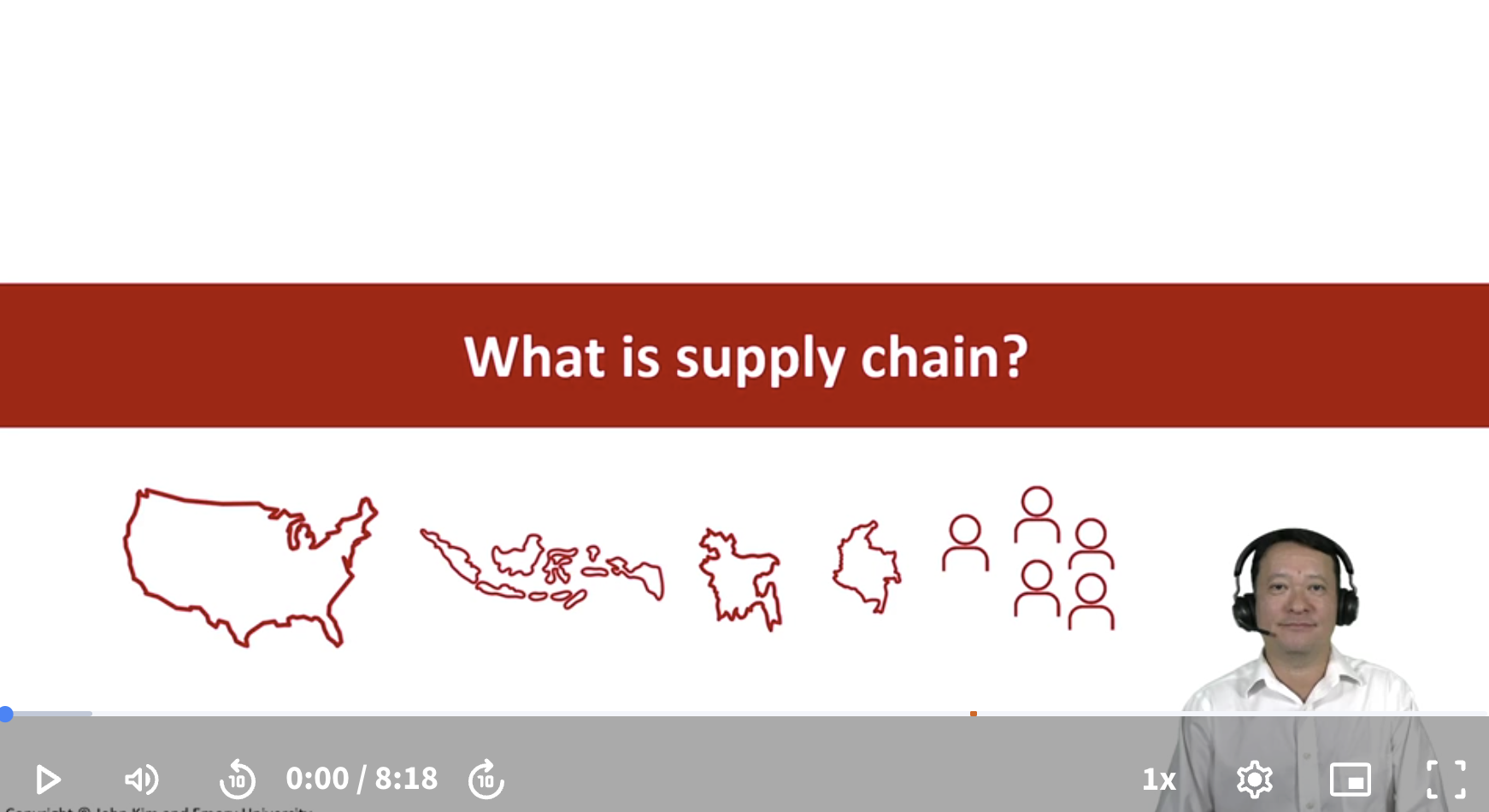
[What is supply chain?]
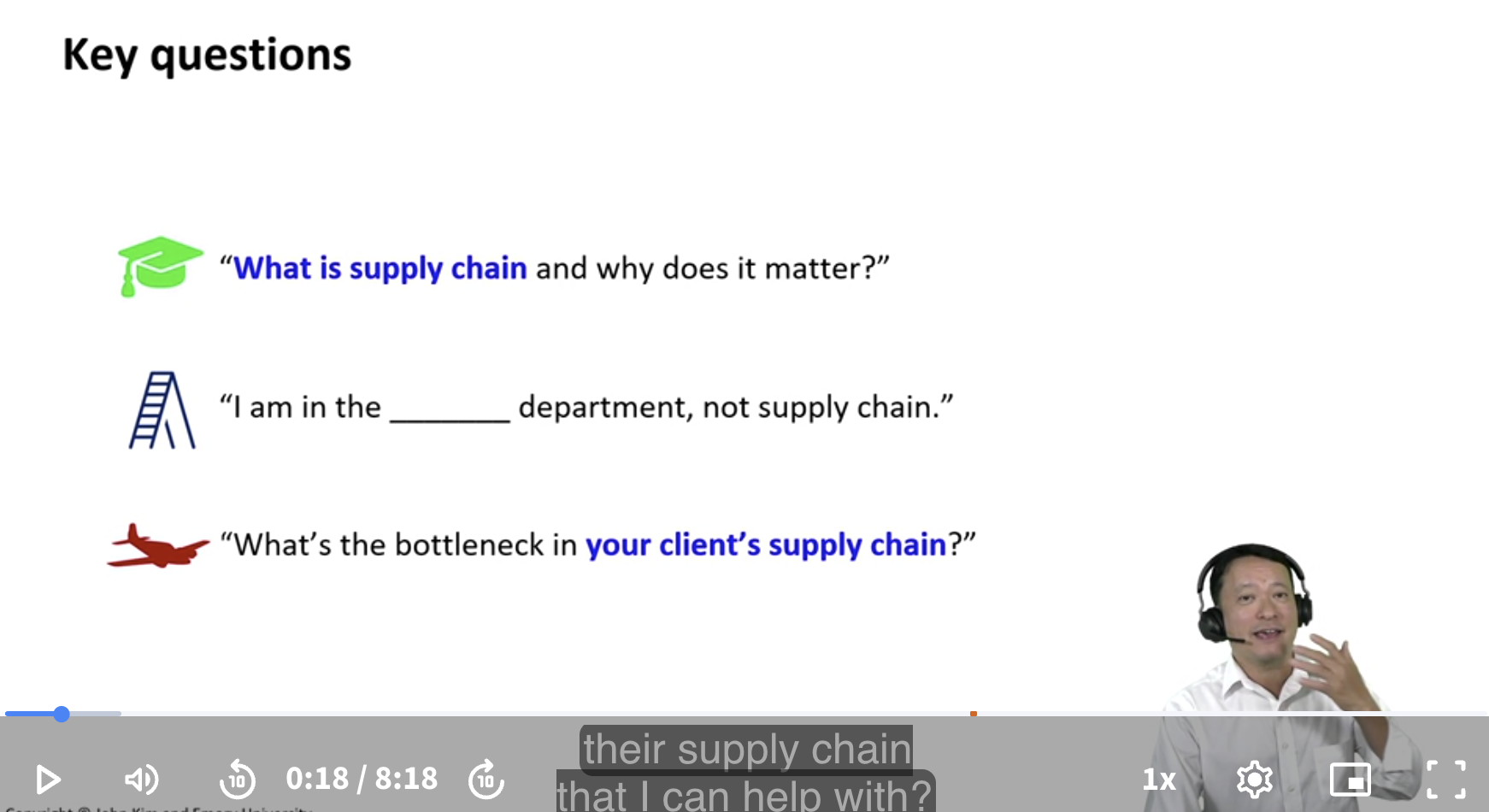
Key questions one might ask.
Graduate: “What is supply chain and why does it matter?”
Manager: “I am in the ________ (say marketing) department, not supply chain.”
Entrepreneur: “What’s the bottleneck in your client’s supply chain?”
Instructor: An Entrepeneur might think, what’s the potential bottleneck that my client or customer is suffering in their supply chain that I can help with?
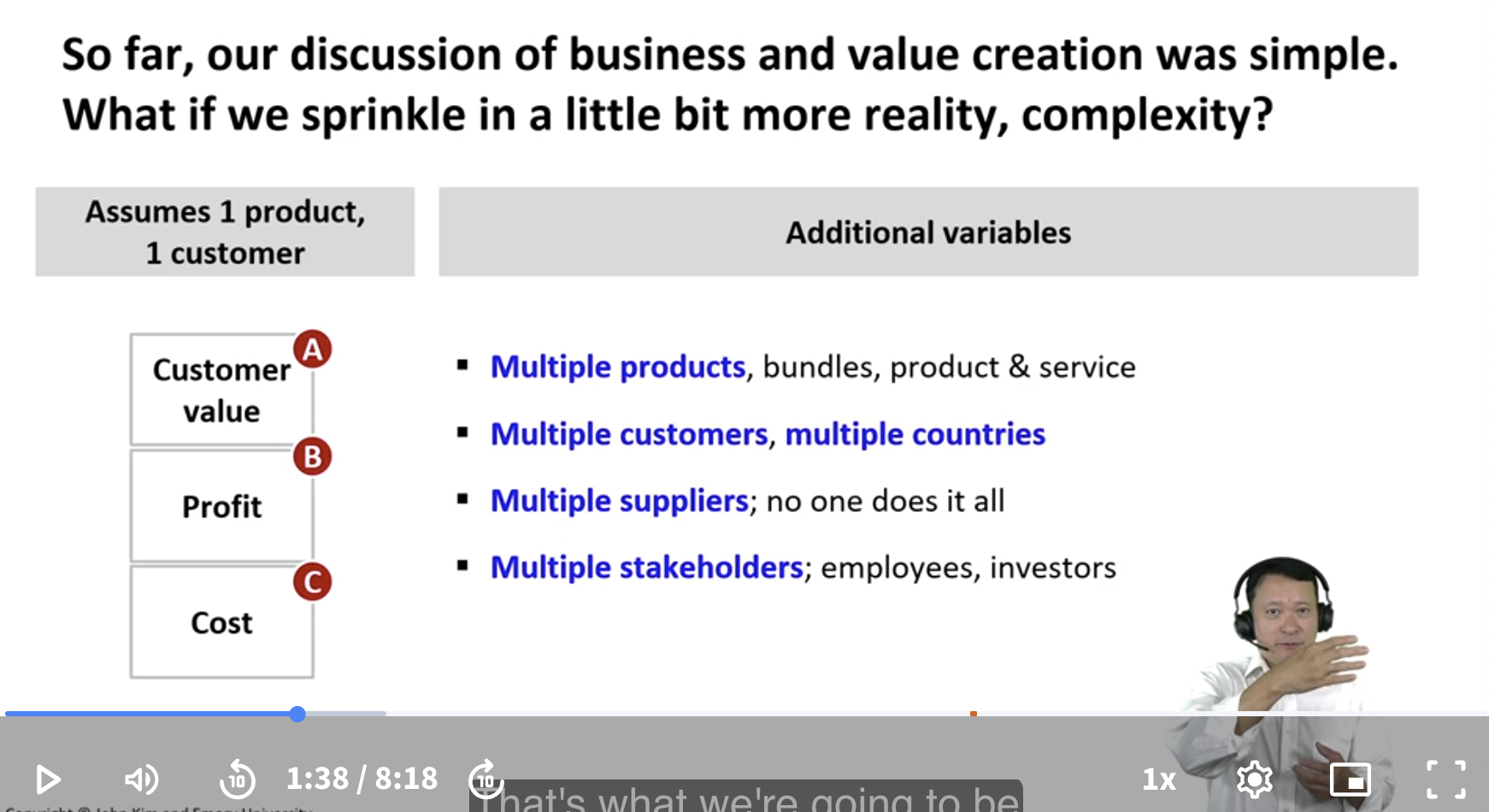
So far, our discussion of business and value creation was simple. What if we sprinkle in a little bit more reality, complexity?
Initially, for the value stack willingness to pay, price, cost, we assumed 1 product and 1 customer.
In reality we have additional variables:
-
Multiple products; bundles, product and service.
-
Multiple customers, multiple countries.
-
Multiple suppliers; no one does it all.
-
Multiple stakeholders; employees, investors.
Instructor: Simple value stack. So far, we’ve had a very simple description of what value, willingness to pay, price, and cost might be. We’re selling one ice cream cone for
$7to one person.
Instructor: Well, we’re not children. We know that the world is much more complex than that.
Instructor: Multiple products. If you think about Dunkin’ Donuts, they might sell ice cream, Baskin, and Robbins, but they also sell doughnuts. Multiple different products and services.
Instructor: Multiple customers. They have a lot of customers. It’s not just one customer, and they might be in multiple countries, US, France, India, Spain, Morocco.
Instructor: Multiple suppliers. They also have multiple suppliers, as companies don’t do everything themselves.
Instructor: Multiple stakeholders. Employees, investors.
Instructor: During the specialization, we want to keep it simple, but we also want to be realistic. Supply chain is a way for us to show how the product goes from here to here to here to here.
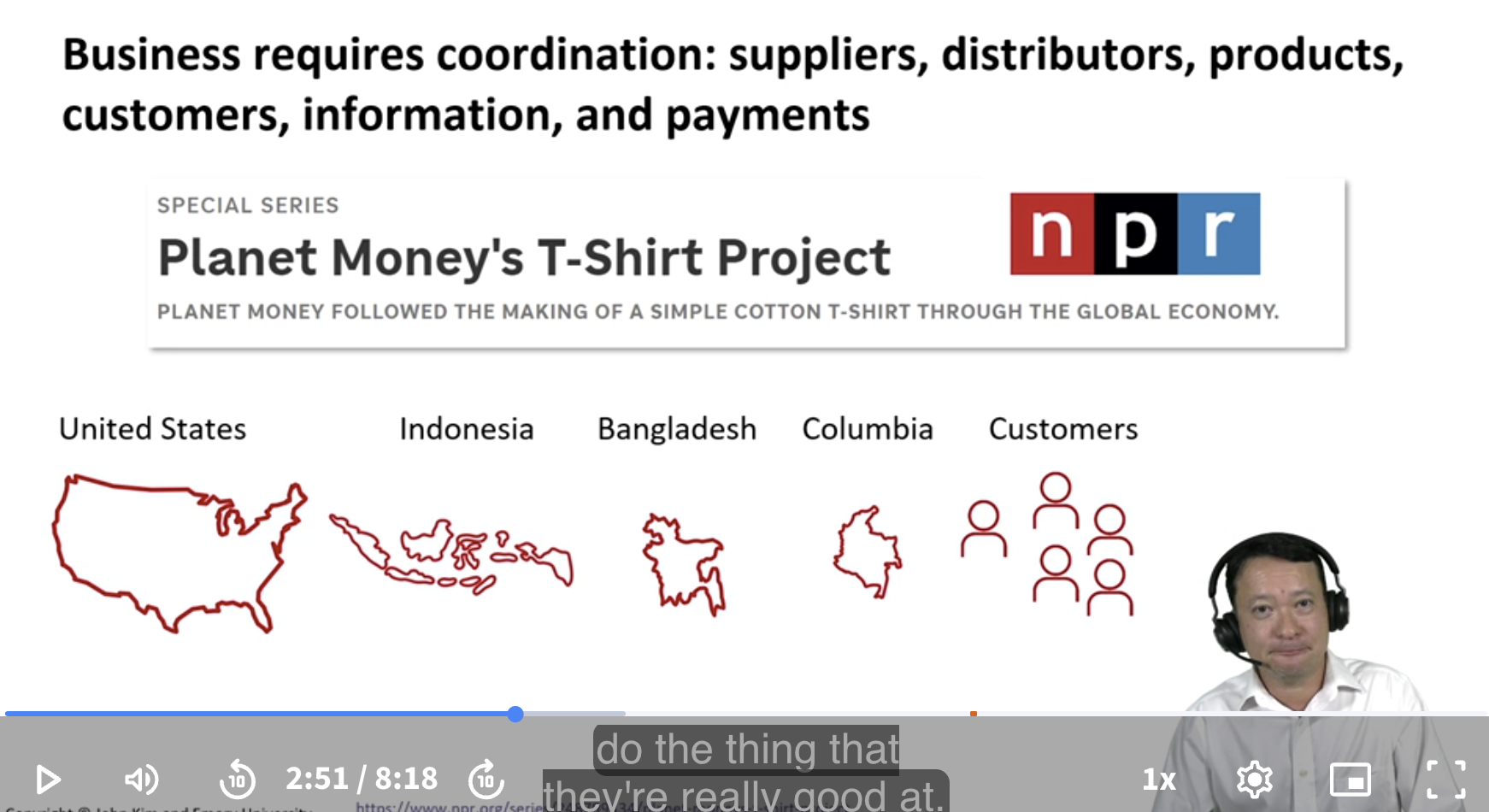
Business requires coordination: suppliers, distributors, products, customers, information, and payments.
Eg: Planet Money T-Shirt Project.
Link: Link.
It’s a series of podcasts where over a year, this radio station here in the United States followed the life of a T-shirt. They followed it from the cotton that they grew in the United States, all the way to Indonesia, Bangladesh, and Colombia, where the cotton was turned into yarn, and from yarn, it was turned into cloth and then from cloth, it was turned into a T-shirt.
cotton ---> yarn ---> cloth ---> t-shirt
Instructor: 1 Massive coordination.
Instructor: 2 Specialization. One of the beautiful things about business is that people specialize in what they’re good at. Instead of one company trying to do everything, we have different people working together to do the thing that they’re really good at.
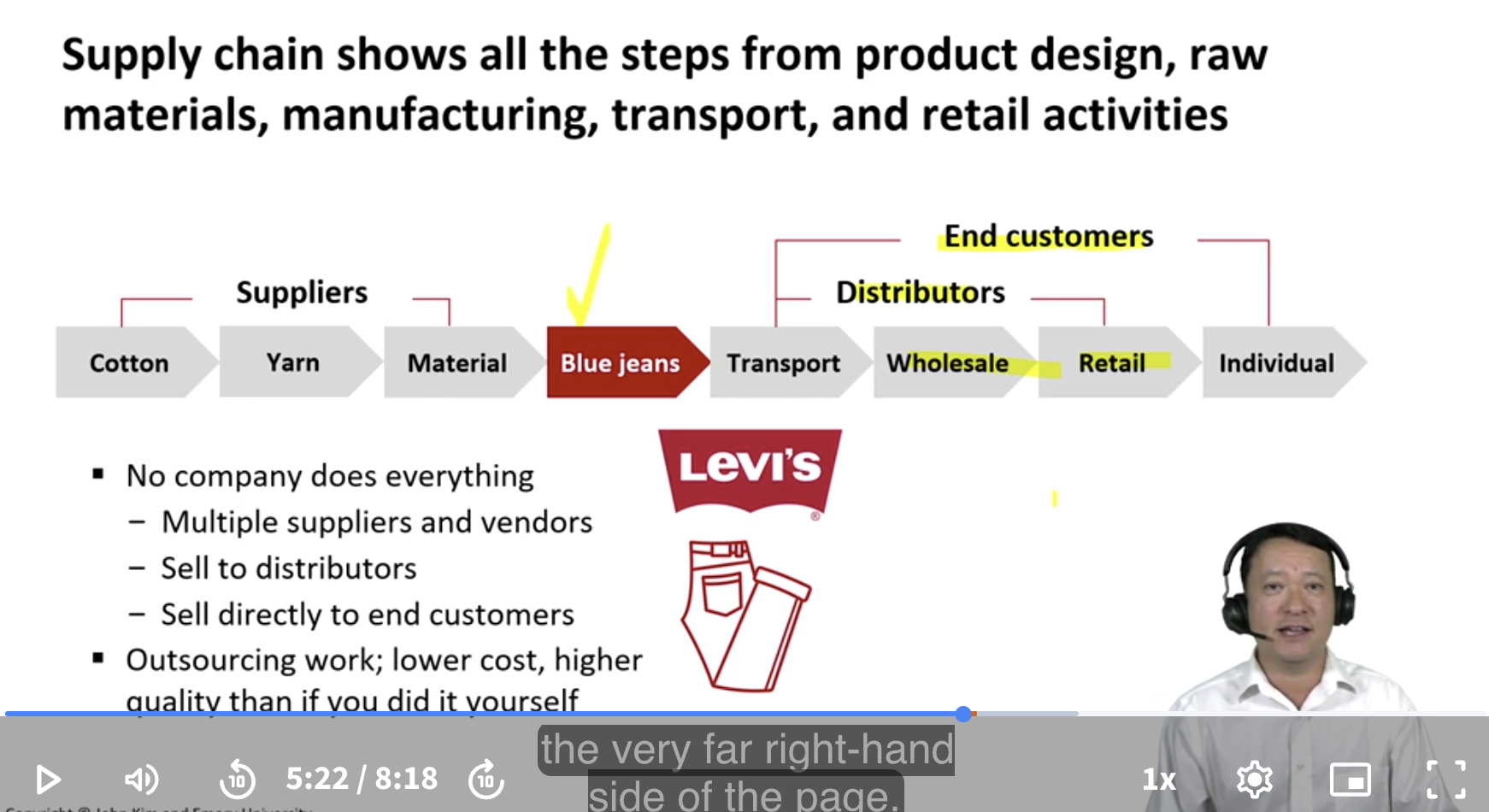
Supply chain shows all the steps from product design, raw materials, manufacturing, transport, and retail activities.
Eg: Blue Jeans.
Cotton ---> Yarn ---> Material ---> [Blue jeans]
[Blue jeans] ---> Transport ---> Wholesale ---> Retail ---> Individual
No company does everything.
-
Multiple suppliers and vendors. (The terms vendor and supplier seem synonymous).
-
Sell to distributors.
-
Sell directly to end customers.
Outsourcing work; lower cost, higher quality than if you did it yourself.
Instructor: Suppliers. You need cotton that gets turned into yarn that gets turned into material. Those are all suppliers. Now, this isn’t the only supplier. Note that blue jeans take equipment and it takes labor. There are many more suppliers here that are not shown. But you get the idea. No one company can do it by themselves. There’s collaboration.
Instructor: Finished product. In the red in the middle is the blue jeans. We have the finished product. It’s all done.
Instructor: How to sell? Then the question is, how do we sell this? Peter Drucker, a very famous management thinker, said ”The purpose of a business is to create a customer.” How do we create a customer? Show me the customer. Well, there’s a couple of ways this could go.
Instructor: One way to sell. One way is that you go through distributors who take it to wholesale and then to retail. You can buy the blue jeans in a store. That’s one method.
Personal: Wholesale vs retail refers to two different ways products move through the supply chain. Wholesale businesses sell products in bulk to other businesses. Retail businesses sell products directly to individual consumers. Link: Link.
Instructor: Another way to sell. Nowadays, with so much delivery and convenience, many people buy their products or clothes or blue jeans directly through Amazon or through Flipkart or walmart (dot) com. There’s a lot of direct-to-consumer, DTC, e-commerce business.
Instructor: Very simply, going from left to right, you can see the flow of product. You can also see that there’s multiple ways for customers to buy the product. One could be wholesale, one could be retail or one could be direct from the company. A lot of times in business, when you talk about the multiple steps that something has, you will see it drawn out from left to right with the customer being on the very far right-hand side of the page.
Key takeaways.
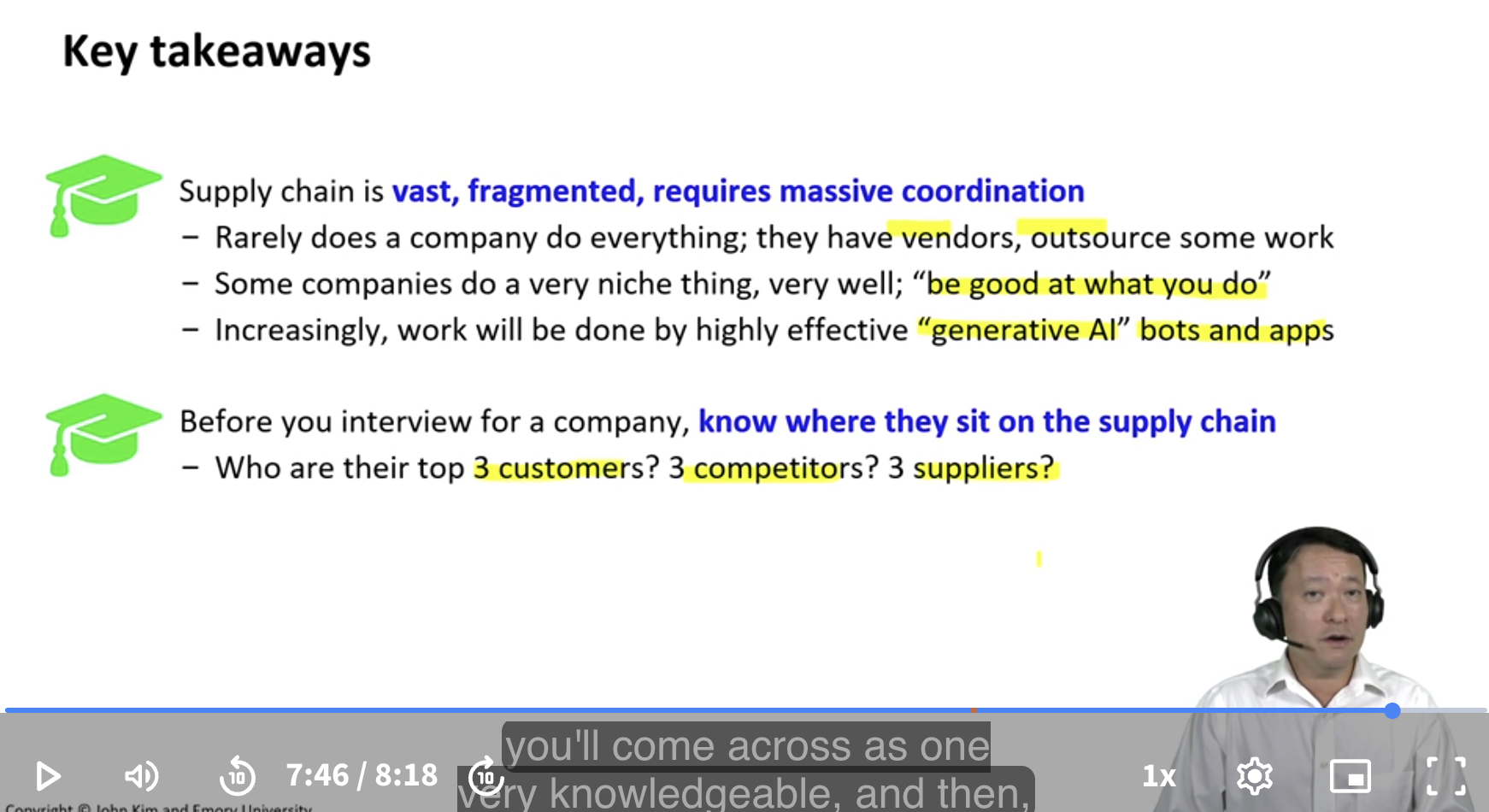
Supply chain is vast, fragmented, requires massive coordination.
-
Rarely does a company do everything; they have vendors, outsource some work.
-
Some companies do a very niche thing, very well; “be good at what you do”.
-
Increasingly, work will be done by highly effective “generative AI’ bots and apps.
Before you interview for a company, know where they sit on the supply chain.
- Who are their top 3 customers? 3 competitors? 3 suppliers?
Instructor: Supply chain is massive. Whenever you see trucks driving on the road, supply chain. You see really long trains that have hundreds of cars attached to it, supply chain. You see big cargo vessels at the port near your house, supply chain.
Instructor: Outsourcing. Very rarely does one company do it all. They all have vendors, and they outsource things.
Instructor: Outsourcing. In business, you need to be good at what you do. If you’re not good at what you do, you will go out of business. Oftentimes, you want to be very good at what you do and really focus on that. For example, for myself, I want to get really good at making these videos for Coursera, and I’m going to focus on that and spend a lot of time. Now, I might not be good at the editing, and I will give that to somebody else to edit it, or I might not be good at the marketing, and I’ll have somebody else do that. That’s also a form of supply chain.
Instructor: Gen AI. I think generative AI is going to make a lot of this coordination in the supply chain even smoother. Because frankly, it requires a lot of emails and paperwork and all this complexity but the more that we can standardize the process, the more that we can have AI to coordinate it, you’re going to see all these applications and bots and agents doing it for us.
Instructor: For students going for an interview with maybe some big company. I think it’s really critical that you know where that company sits on their own supply chain. I want you to do your homework. Know who are their customers? Who are their competitors, and who are their suppliers? How do all these dominoes connect with each other? Because when you’re having an interview, if you can talk about it in those terms, one you’ll come across as very knowledgeable, and two it’s a very smart way to organize your thoughts.
Personal:
Know where a company sits in the supply chain.
Suppliers ---> Company ---> Customers
Look at the top 3 customers. The top 3 competitors. The top 3 suppliers.
Quote of the day
Coming together is a beginning;
keeping together is progress;
working together is success.

- Henry Ford.